


Staring at the four walls of your studio apartment and feeling like they’re slowly closing in? Yeah, I’ve been there. My first apartment was a glorified closet with a window, and for the first month, I felt like I was living inside a shoebox. A very expensive shoebox, I might add. The good news? That tiny space forced me to get creative, and I quickly realized that a studio apartment isn’t a limitation; it’s a launchpad for some seriously clever design.
You don’t need a sprawling mansion to live in style. In fact, some of the coziest, most functional, and personality-packed homes I’ve ever seen have been studios. The secret isn’t magic (though a self-cleaning apartment would be nice). It’s about smart choices, a little bit of planning, and thinking of your home as one cohesive, brilliant machine for living.
So, grab a coffee, get comfy, and let’s talk about how to turn your small studio into a space you’ll genuinely love showing off. Forget what you think you know about small-space living. We’re about to break some rules and have a little fun.
1. Master the Art of Multifunctional Furniture Layouts
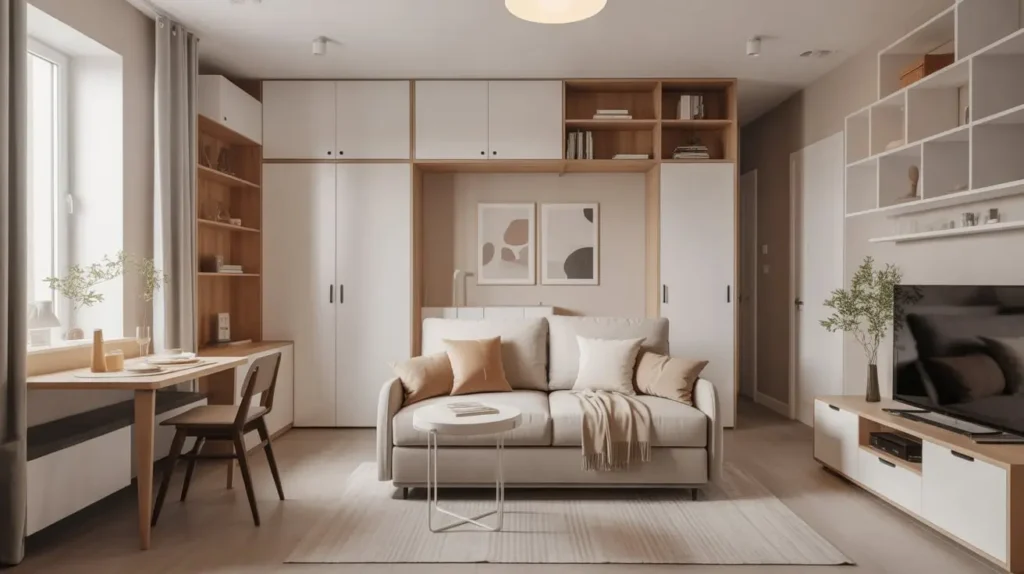
Let’s get one thing straight: in a studio, every piece of furniture needs to earn its keep. If something only serves one purpose, it’s freeloading. Think of your furniture as a team of hardworking employees. You want the overachievers, the ones who can multitask without complaining.
The All-Star Players
I’m talking about pieces that pull double, or even triple, duty. An ottoman with hidden storage is a classic for a reason. It’s a footrest, an extra seat for guests, a makeshift coffee table (with a tray on top), and a secret home for your throw blankets or that guilty-pleasure magazine collection.
A coffee table that lifts up to become a dining or work surface is another game-changer. I had one of these in my second apartment, and it was incredible. It went from a low-profile living room piece to my full-fledged dining table in about three seconds. No more eating dinner hunched over on the couch like a goblin.
Think Beyond the Obvious
Your “dining table” doesn’t have to be a traditional table. A narrow console table behind your sofa can serve as a place for lamps and decor, but pull up a stool, and it instantly becomes a breakfast bar or a workspace. It’s all about seeing the potential in every piece.
2. Reach for the Sky with Lofted Bed Studio Transformations
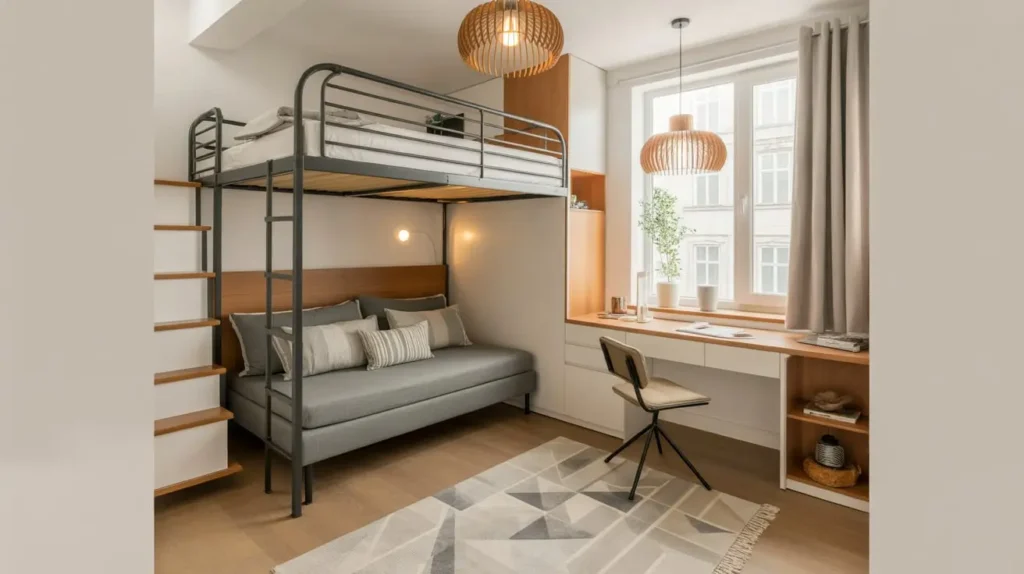
Okay, this one is a bit more of a commitment, but hear me out. The single biggest space-hog in any studio apartment is the bed. It just sits there, taking up a massive chunk of your precious floor space. So, what if you could just… lift it out of the way?
Lofting your bed is the ultimate power move in a studio. It literally doubles your usable square footage in that area. Suddenly, you have an entire room’s worth of space underneath. What do you do with all that newfound territory? The possibilities are endless.
Creating Your “Downstairs”
- The Ultimate WFH Zone: Tuck a desk, a comfy chair, and some shelving underneath your bed. You’ve just created a dedicated office that feels separate from your sleeping area. This is a huge psychological win.
- A Walk-In Closet: Who says you can’t have a walk-in closet in a studio? Install a rod for hanging clothes, add some drawers and shelves, and you’ve got a dressing area that was previously just… floor.
- A Mini Living Room: A small loveseat or a couple of cozy armchairs and a small rug can turn the under-loft space into a perfect spot for reading or having a friend over.
A quick word of warning from personal experience: invest in a sturdy loft bed. My college roommate had a wobbly one, and every time he rolled over, it felt like a minor earthquake. Check the weight limits, make sure it’s assembled correctly, and you’ll sleep soundly, high above your new domain.
3. Embrace Your Inner Minimalist (Without Being Boring)
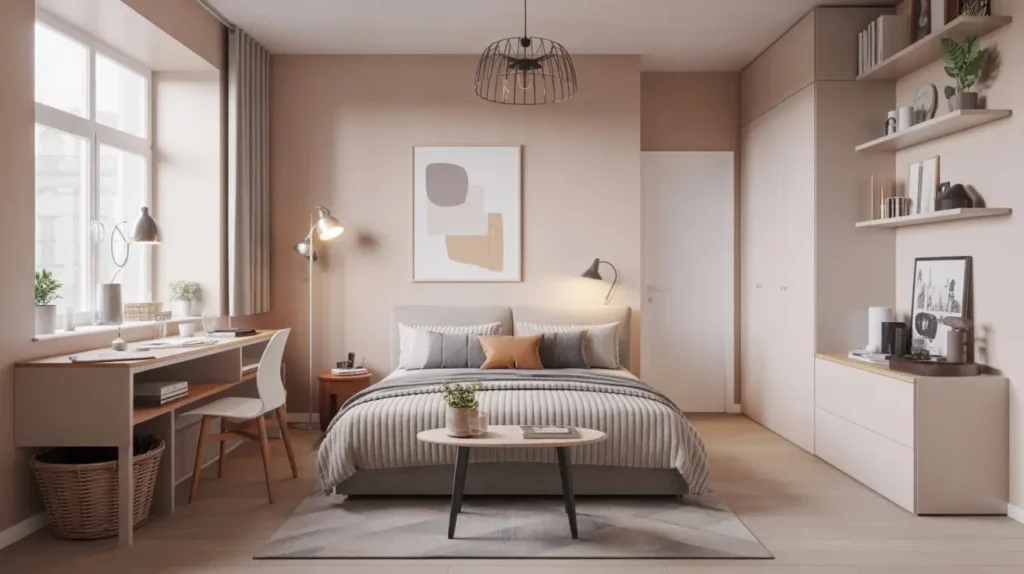
When people hear “minimalism,” they often picture a cold, white room with one sad-looking chair in the corner. Let’s get rid of that idea. Minimalism isn’t about deprivation; it’s about intention. It’s about surrounding yourself only with things that are useful, beautiful, or that you truly love.
In a small studio, this philosophy is your best friend. Clutter is the enemy of small spaces. It makes them feel chaotic, cramped, and stressful. By being selective about what you bring into your home, you give your favorite pieces room to breathe and shine.
Ever wonder why those design magazines look so good? It’s not just the fancy furniture. It’s the lack of junk. I try to follow a “one-in, one-out” rule. If I buy a new decorative pillow, an old one has to go. If I buy a new book, I donate one I’ve already read. It keeps the clutter creep at bay. Honestly, it’s the only thing stopping my apartment from turning into a museum of quirky coffee mugs.
4. Get Sneaky with Creative Storage Solutions
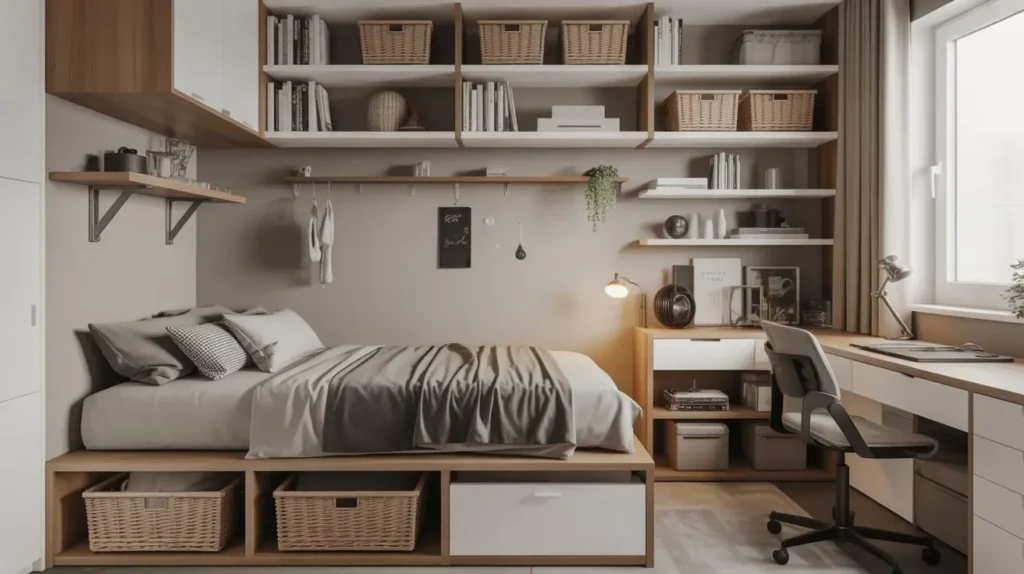
When you live in a studio, you have to become a storage ninja. Think vertically, think hidden, think creatively. Your mission is to find a home for everything you own without making your apartment look like a self-storage unit.
Go Vertical, Young Decorator!
Your walls are your greatest untapped resource. Instead of a wide, clunky bookcase, opt for tall, narrow shelving units that draw the eye upward and make the ceiling feel higher. I’m a huge fan of ladder-style bookshelves for this. They have a small footprint but offer a ton of storage.
Another brilliant vertical solution is a pegboard. You can hang one in your kitchen for pots and utensils, near your entryway for keys and bags, or above your desk for office supplies. They are infinitely customizable and, IMO, look super chic and industrial.
Hidden-in-Plain-Sight Storage
- Under-bed storage: If a loft bed isn’t for you, at least get a bed frame that’s high enough to slide some storage containers underneath. Look for low-profile bins with wheels for easy access.
- Storage benches: A bench at the foot of your bed or in your entryway can hide a multitude of sins, from extra shoes to workout gear.
- Think inside the box: Use dividers inside your drawers to keep things organized. It’s a small change that makes a massive difference in how much you can fit and find.
Read Also 15 Clever Apartment Decorating on a Budget Ideas for Modern Style
5. Carve Out a Cozy Reading Nook

“A reading nook? In my tiny studio?” Yes, you! Even in the smallest of spaces, creating designated zones is crucial for your sanity. You need a spot that signals “time to relax,” a place that isn’t your bed or your desk.
This doesn’t have to be some grand, built-in affair. A reading nook can be as simple as a comfortable armchair tucked into a corner. Add a small side table for your tea, a soft throw blanket, and a good floor lamp, and you’ve created a destination.
I once used a large, oversized floor cushion, a few pillows, and a small stack of books to create a nook right by a window. It took up minimal space but gave me a dedicated spot to unwind that felt completely separate from the rest of my apartment. It’s about creating a feeling, an experience, within your four walls.
6. Hack Your Space with a Smart Color Palette
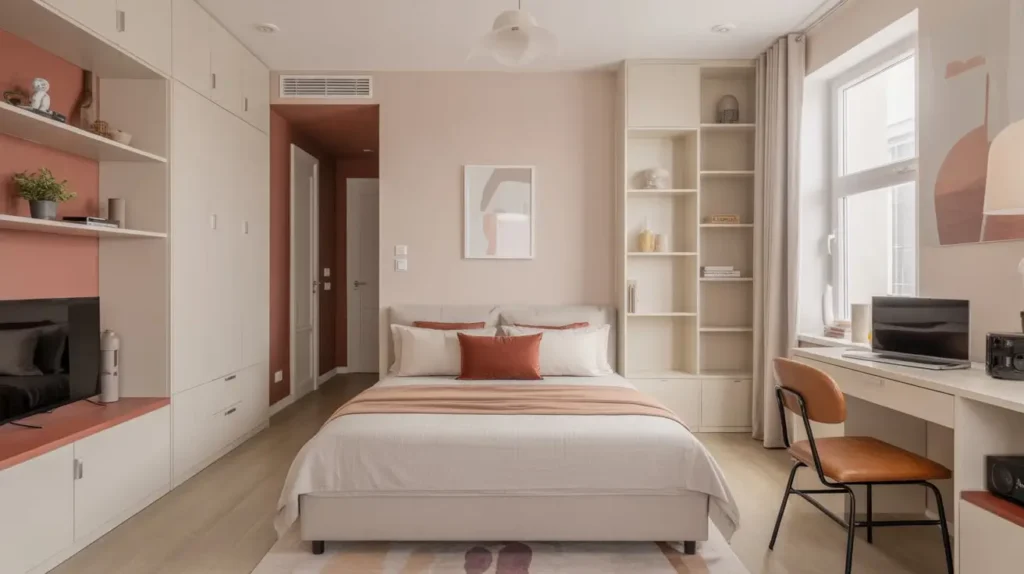
Color is one of the most powerful and inexpensive tools in your design arsenal. The right color palette can make your studio feel bigger, brighter, and more cohesive. The wrong one can make it feel like a cave.
The Light and Airy Approach
It’s a well-known rule for a reason: light colors make a space feel larger and more open. Whites, soft grays, pale blues, and warm beiges reflect light, which helps to create an airy, expansive feeling. This doesn’t mean your apartment has to be sterile and white. You can choose a warm off-white or a very light greige to add some character.
Does this mean you’re doomed to a life without bold color? Absolutely not. That’s where the accent wall comes in. Painting the wall behind your bed or sofa a deep, moody color—like navy, charcoal, or emerald green—can actually create an illusion of depth. It makes that wall recede, which tricks the eye into thinking the room is longer than it is. It’s a bit of design voodoo, but it works.
A great guideline to follow is the 60-30-10 rule.
- 60% of your room should be your dominant, neutral color (walls, large furniture).
- 30% should be a secondary color (rugs, curtains, accent chairs).
- 10% should be your accent color (throw pillows, art, small decor).
This formula ensures a balanced and harmonious look every time.
7. Fold It, Flip It, Convert It: The Magic of Convertible Furniture
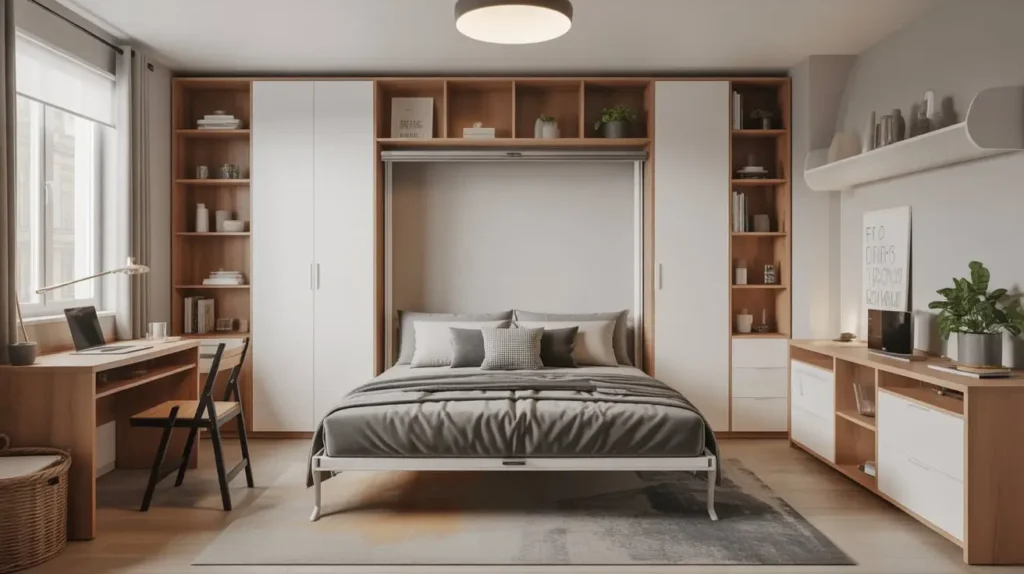
This is the next level of multifunctional. We’re talking about furniture that physically transforms to meet your needs. It’s like having a team of tiny robots reconfiguring your apartment on command. Okay, not really, but it’s close.
The King of Convertibles: The Murphy Bed
The Murphy bed, or wall bed, is the undisputed champion of space-saving. For decades, people have used these to reclaim their living space during the day. Modern Murphy beds are nothing like the clumsy, scary contraptions you’ve seen in old cartoons. They are sleek, safe, and often come with integrated shelving or even a built-in sofa or desk.
Yes, they are an investment. But if you’re in a studio for the long haul, being able to fold your entire bed into the wall and have a full living room is priceless.
Other Transformers to Consider
- Drop-leaf tables: These are fantastic. You can have them folded down and pushed against a wall as a slim console table, lift one “leaf” for a one-person desk, or lift both to create a dining table for four.
- Nesting tables: Instead of one bulky coffee table, a set of two or three nesting tables gives you flexibility. You can keep them tucked together for daily use and pull them out when you have guests.
- Foldable chairs: Don’t keep four dining chairs out if you only use one. Invest in a couple of stylish, comfortable foldable chairs that you can hang on the wall or tuck in a closet until they’re needed.
8. Defy Gravity with Wall-Mounted Shelves and Decor

One of my personal design mantras is: get it off the floor! The more floor space you can see, the larger and less cluttered your room will feel. Wall-mounting is your secret weapon to achieve this.
Think about all the things currently sitting on your floor. A TV stand? A bookshelf? A nightstand? All of these can be mounted on the wall. A wall-mounted TV console or floating shelves create a clean, modern look and make it a thousand times easier to vacuum. Who doesn’t love that? 🙂
I particularly love floating nightstands. They give you a place for your lamp, book, and phone without taking up any floor space. It makes the area around your bed feel so much more open. The same goes for desks. A simple wall-mounted shelf at the right height can serve as a minimalist, space-saving desk.
9. Conquer Kitchen Chaos with Space-Saving Organization
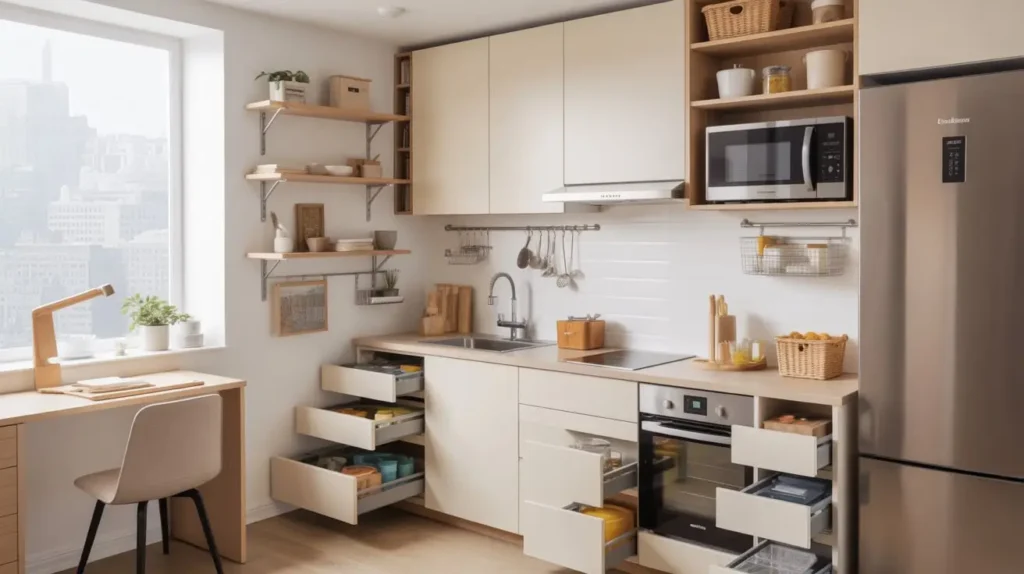
Studio apartment kitchens are notoriously tiny. Sometimes they’re just a sad little wall with a sink and a mini-fridge. But even the smallest kitchenette can be a functional and even enjoyable place to cook if you organize it like a pro.
The key is to maximize every single inch. Your counter space is prime real estate, so keep it as clear as possible.
Must-Have Studio Kitchen Organizers
- Magnetic Knife Strip: Get those knives out of a clunky block and onto the wall. It saves counter space, and frankly, it looks pretty cool and professional.
- Over-the-Sink Drying Rack: This is a revelation. It’s a rack that sits over your sink, so you can wash dishes and let them drip-dry directly into the basin without using up a single inch of your counter.
- Tension Rods: Use a small tension rod under your sink to hang spray bottles by their triggers, freeing up the cabinet floor for other supplies. You can also use one inside a cabinet to organize cutting boards or baking sheets vertically.
- Wall-Mounted Pot Rack or Pegboard: Get your pots, pans, and utensils up on the wall. This frees up an entire cabinet and makes it easy to grab what you need while you’re cooking.
Read Also 15 Modern Studio Apartment Ideas for Men and Space-Saving Tricks
10. Let There Be Light: Studio Apartment Lighting Tricks

Bad lighting is a crime in any home, but in a small studio, it’s a felony. A single, sad overhead light (I call it the “interrogation lamp”) creates harsh shadows and makes a room feel small and gloomy. The solution is layered lighting.
You need to think about lighting in three layers:
- Ambient Lighting: This is your overall illumination. Yes, it can be an overhead fixture, but make it a good one! A stylish flush-mount or a modern chandelier can be a statement piece. Always use a dimmer switch.
- Task Lighting: This is focused light for specific activities. Think of a reading lamp by your armchair, under-cabinet lighting in your kitchen, or a desk lamp in your WFH corner. This is the light that makes your space truly functional.
- Accent Lighting: This is the fun part. Accent lighting adds mood and personality. It can be a small lamp that uplights a plant, picture lights over your favorite art, or even some warm-toned string lights draped around a mirror.
By combining these three types of light, you create depth, warmth, and the illusion of a larger, more dynamic space.
11. Become a Plant Parent: Small Apartment Plant Styling
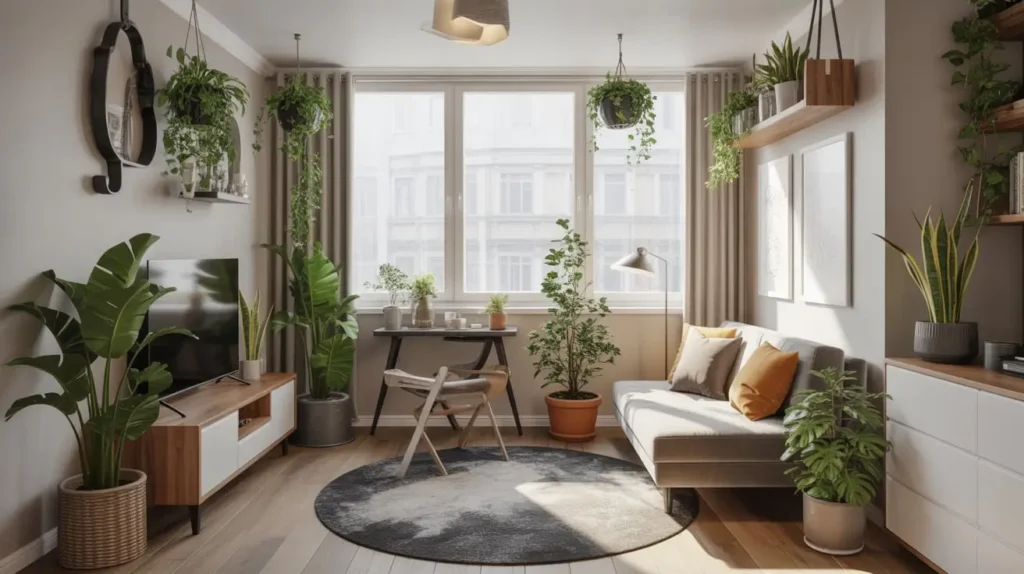
Plants are magic. They add life, color, and texture to a room, and they can even help purify the air. In a studio, they can also be used as subtle, natural design elements to define spaces.
You don’t need a jungle (unless you want one). A few well-placed plants can make a huge impact. Since floor space is at a premium, think vertically. Hanging plants are a studio dweller’s best friend. A pothos or philodendron trailing down from a hook in the ceiling draws the eye up and adds a beautiful, organic element.
Also, look for tall, skinny plants like a Snake Plant or a Fiddle Leaf Fig. They provide a lot of vertical impact without having a wide footprint. You can tuck one in a corner to add height and drama. Grouping a few small plants of varying heights on a windowsill or shelf also creates a lovely little vignette. And if you’re like me and have a history of plant-slaughter, start with something notoriously hard to kill. FYI, the snake plant is practically indestructible.
12. Zone Out with Open Floor Plan Studio Designs
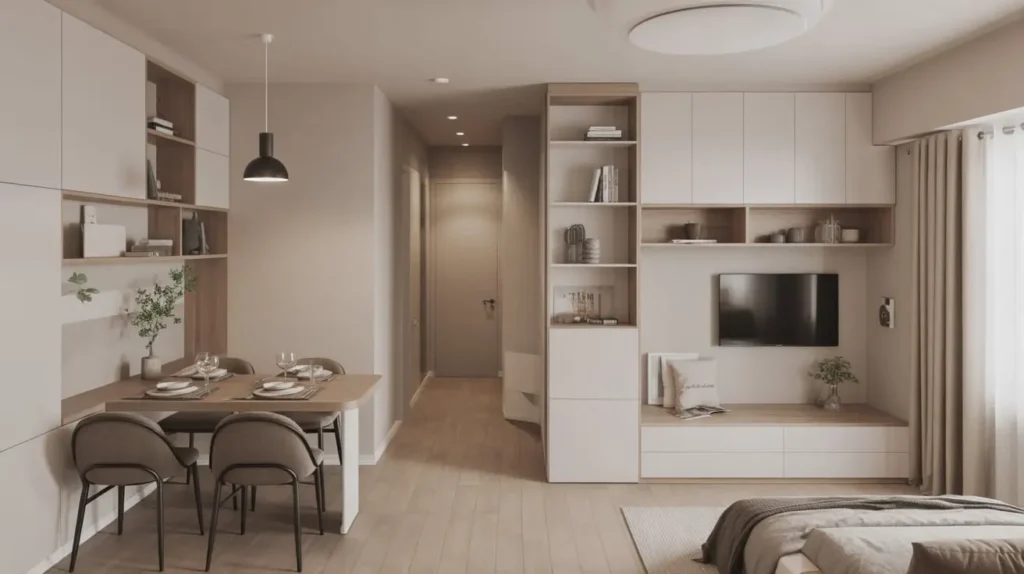
Your studio is one big room, but it doesn’t have to feel like one big room. The trick is to create distinct “zones” for sleeping, living, and eating. This psychological separation makes your space feel more organized and intentional, just like a larger home with actual walls.
So, how do you create rooms without walls?
- The Power of the Rug: A well-placed rug is the easiest way to define a zone. A large rug under your sofa, coffee table, and armchair clearly says, “This is the living room.” It creates a visual boundary that separates it from, say, your sleeping area.
- Use Furniture as Dividers: An open-back bookshelf (like an IKEA Kallax unit) is the perfect studio apartment room divider. It separates the space between your bed and your living area while still allowing light to pass through. You can also use it for storage and display!
- A Splash of Paint: You can paint a “zone” on the wall to visually separate a space. For example, painting a wide vertical stripe or an arch behind your desk area instantly designates it as your office. It’s a bold move, but it pays off.
13. Use Mirrors and Other Optical Illusions for Space
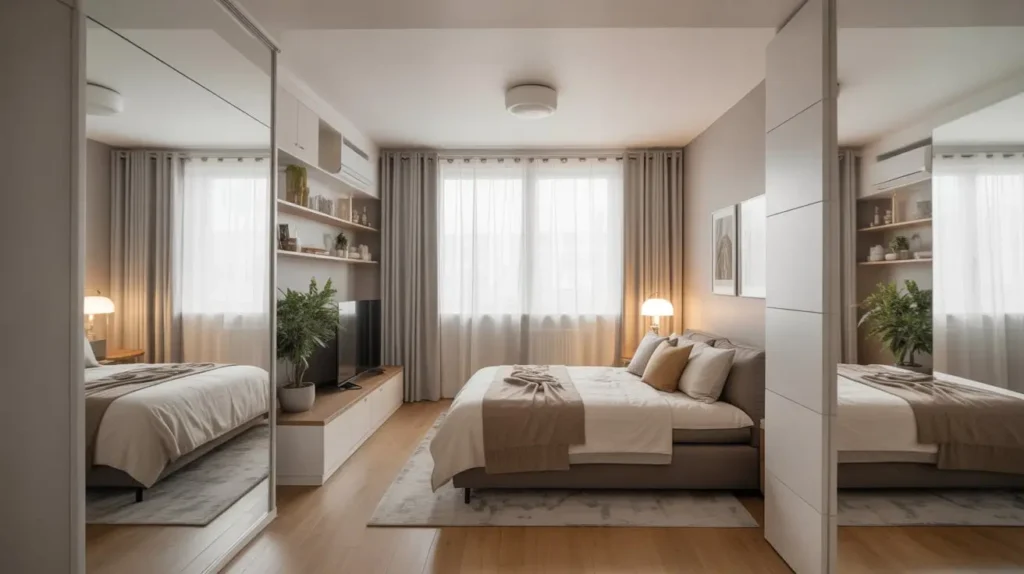
Ready to play some tricks on your brain? Decorating a small space is all about optical illusions, and your number one tool is the mirror.
The oldest trick in the book is still the best: a large mirror will make any room feel bigger and brighter. The key is placement. Hang a large, floor-length mirror leaning against a wall, or place a big mirror directly opposite a window. It will reflect the view and all that natural light, effectively creating a “second window” and doubling the brightness of your space.
But don’t stop at mirrors. Other materials can create a similar effect. Furniture made of clear acrylic or lucite (sometimes called “ghost furniture”) is amazing for small spaces. A ghost coffee table or console table does its job without taking up any visual space. The eye sees right through it, making the room feel less crowded.
Another great trick is to choose furniture with raised legs. A sofa, armchair, or bed frame that is lifted off the ground allows you to see the floor underneath, which creates a sense of openness and flow. It’s a subtle difference that has a massive impact.
14. Create a Compact and Chic Work-from-Home Corner
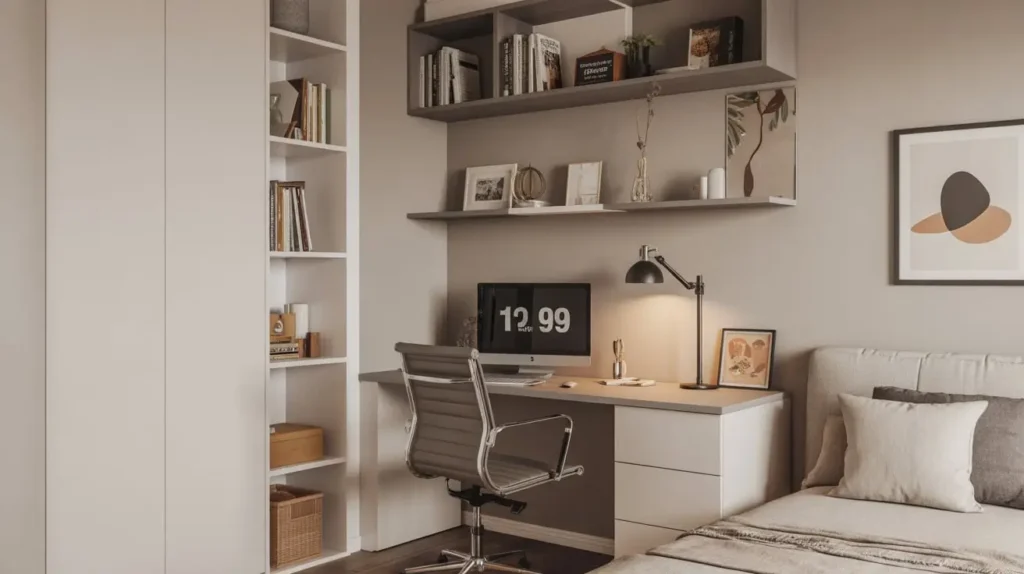
In today’s world, many of us need a dedicated workspace, even in a studio. Working from your bed or your sofa is bad for your back and terrible for your work-life balance. You need a spot that, when you sit down, tells your brain, “It’s time to focus.”
You don’t need a whole room. A small, well-designed corner is all it takes. A secretary desk is a fantastic vintage-inspired option. It’s a small desk with a top that folds up to hide your work clutter when you’re done for the day. Out of sight, out of mind.
A floating or wall-mounted desk is another brilliant solution, as we’ve discussed. It uses zero floor space and can be tucked into an unused nook. Pair it with a stylish (but ergonomic!) chair and some wall-mounted shelving for your supplies, and you’ve got a fully functional office that doesn’t scream “corporate cubicle.”
15. Your Budget-Friendly Studio Makeover Guide

Feeling inspired but worried about your bank account? Don’t be. You absolutely do not need to spend a fortune to make your studio apartment look amazing. Some of the most impactful changes are also the most affordable.
High-Impact, Low-Cost Ideas
- Thrift and Upcycle: Facebook Marketplace, thrift stores, and flea markets are your best friends. You can find incredible, unique pieces of furniture for a fraction of the retail price. A coat of paint or some new hardware can completely transform a dated dresser or side table.
- DIY Art: You don’t need to be Picasso. Stretch a cool piece of fabric over a canvas frame, print high-resolution public domain images online, or even frame beautiful greeting cards or wallpaper samples. Meaningful, personal art is always better than generic store-bought stuff.
- Peel-and-Stick Power: Hate your kitchen backsplash or a boring wall? Peel-and-stick wallpaper or tiles are a renter-friendly, low-commitment way to add a huge dose of personality. They are easy to apply, and even easier to remove when you move out.
- Textile Refresh: The fastest way to change the feel of your room is to swap out the textiles. A new duvet cover, a colorful throw blanket, and some new pillow covers can completely transform your space in under an hour for a minimal cost.
Your Studio, Your Sanctuary
There you have it—15 ideas to take your studio from a cramped box to a clever, cozy, and completely custom home. Remember, the goal isn’t to make your studio look like a huge house. The goal is to make it the best possible version of itself.
Embrace the coziness, get creative with your solutions, and edit mercilessly. Your small space is a blank canvas. It’s an opportunity to be intentional, to curate a home that is 100% you, with no wasted space. Now, which idea are you going to try first? Go make your small space mighty.