


Let’s be real for a second. Living in a small home is a charming adventure… until you trip over a laundry basket for the third time and realize your “laundry room” is actually just a forgotten corner of your kitchen. I’ve been there. My first apartment was so tiny, I’m pretty sure my hamster had more square footage. The idea of a dedicated laundry room was a fantasy, right up there with a walk-in closet and a self-cleaning oven.
But what if I told you that you don’t need a sprawling suburban house to have a functional, and dare I say stylish, laundry setup? The secret, my friend, is the glorious pantry laundry room combo. It’s the design world’s best-kept secret for maximizing every last inch of your home. It’s about being clever, a little bit sneaky, and a whole lot practical.
So, grab your favorite beverage, get comfortable, and let’s walk through 15 brilliant ideas that will completely change how you think about that pile of dirty clothes and your collection of canned beans. We’re about to turn a chore into a feature.
1. The Hidden Washer Pantry Wall
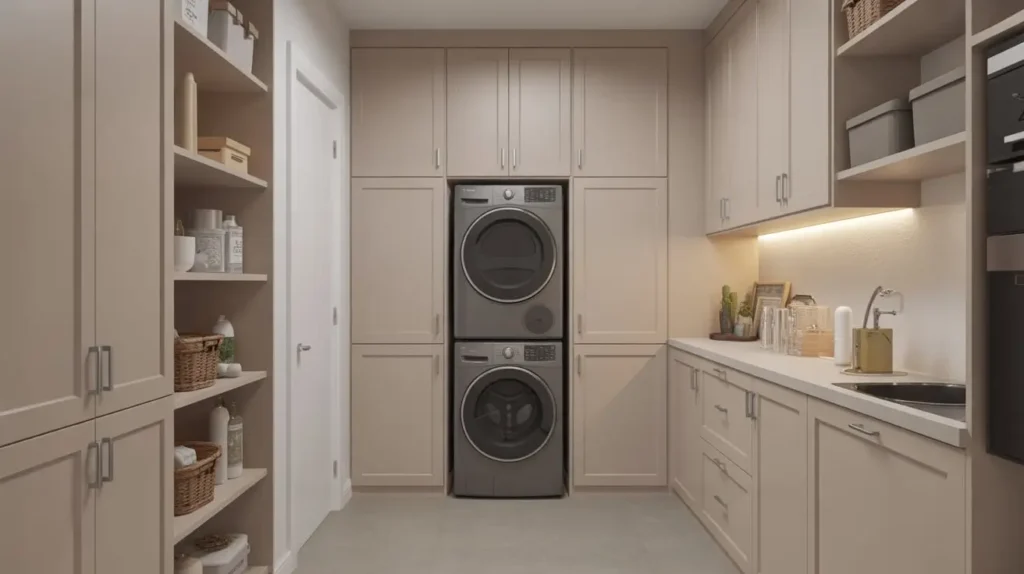
Imagine a seamless wall of beautiful pantry cabinets in your kitchen or hallway. It looks sleek, uniform, and completely unassuming. A guest might open one door to find your impressive stash of pasta and quinoa. But then, they open another, and—surprise!—there’s a full-fledged washer and dryer staring back at them.
This is the magic of the hidden washer pantry wall. It’s the ultimate “now you see it, now you don’t” solution for homeowners who crave a clean, minimalist aesthetic. You’re essentially creating a false wall of cabinetry where some of the cabinets are, well, not cabinets at all.
Why It’s a Stroke of Genius
This idea is all about integration. Instead of having appliances sticking out like a sore thumb, you tuck them away behind doors that match your existing cabinetry. This creates an incredibly cohesive and high-end look. It makes your space feel intentional and clutter-free, which is the holy grail of small-home living, isn’t it?
My Two Cents on Making It Work
If you’re going this route, custom cabinetry is your best friend. Off-the-shelf solutions might not fit your specific appliances or space perfectly. You’ll also need to think about the practical stuff. Ensure there’s proper ventilation for the dryer, especially if it’s a vented model. Also, plan for plumbing and electrical access. A good cabinet maker can build in discreet vents and access panels that don’t ruin the look.
- Key Consideration: Use heavy-duty hinges on the cabinet doors. Appliance doors get opened and closed a lot, and you don’t want them sagging over time.
- Pro-Tip: Opt for a ventless condensing dryer or a heat pump dryer. These don’t require external venting, giving you way more flexibility on where you can place your hidden laundry station.
- Storage Integration: The cabinets directly above the washer and dryer are the perfect spot for laundry detergents, fabric softeners, and other supplies.
2. The Vertical Shelving Combo Zone
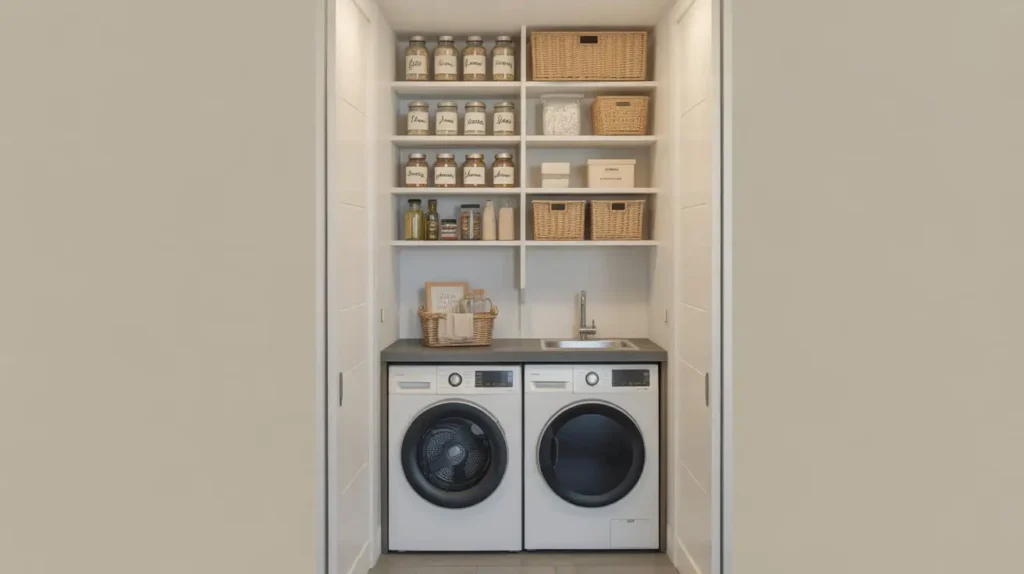
When you can’t build out, you build up! This is the fundamental rule of small-space living, and the vertical shelving combo zone embodies it perfectly. This idea is less about hiding and more about organizing everything in one hyper-efficient vertical column.
Think of it as a dedicated tower of power. At the bottom, you place your washer and dryer (either side-by-side or stacked). Then, from the top of the appliances all the way to the ceiling, you install sturdy, open shelving. This creates a single, consolidated zone for both your laundry supplies and your pantry goods.
The Beauty of Going Up
The genius here is its efficiency. You’re using valuable vertical real estate that often goes to waste. By stacking your storage, you keep everything you need in one easy-to-access spot. No more running to the kitchen for a can of tomatoes while your laundry is running in the hallway closet.
A Friendly Word of Warning
Make sure your shelves are securely anchored to the wall, especially the higher ones. You’ll be storing heavy items like jars, cans, and bulk laundry detergent. The last thing you want is a disastrous (and messy) avalanche. Also, be realistic about what you store on the top shelves. Unless you’re a professional basketball player, you’ll want a sturdy step stool handy for reaching those rarely-used items.
- Organization is Key: Use clear containers, baskets, and labels. With open shelving, everything is on display, so a little organization goes a long way in preventing a chaotic look.
- Aesthetic Tip: Use matching baskets or bins for a uniform look. You can store things like dryer sheets, stain removers, and miscellaneous pantry items (like bags of chips) in these bins to hide the visual clutter.
3. The Sliding Door Laundry Pantry
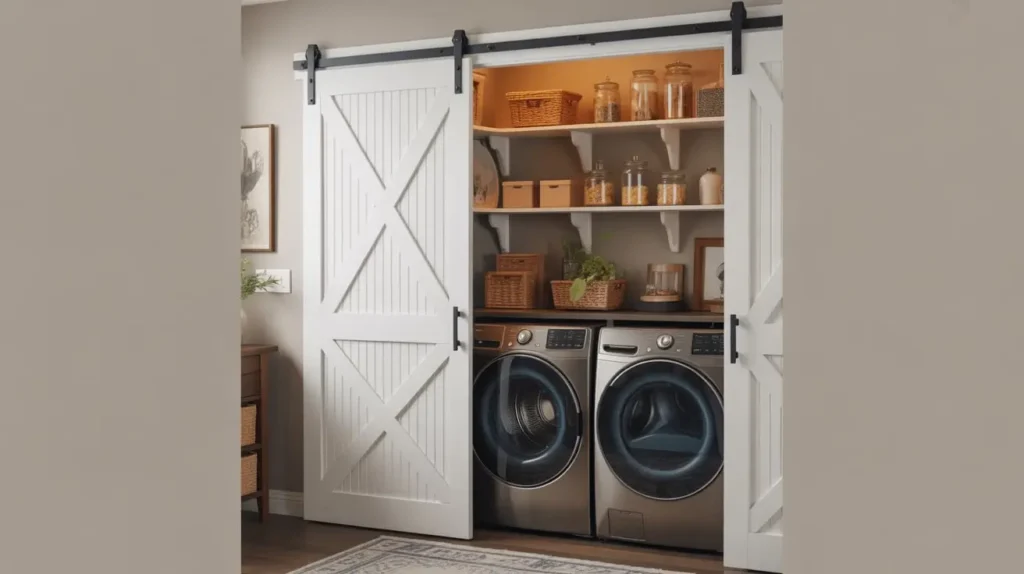
Traditional swing-out doors are space hogs. In a narrow hallway or a tight corner, the arc of a swinging door can make the area completely unusable. Ever tried to sidle past an open door while carrying a full laundry basket? It’s a dance of frustration I know all too well.
Enter the sliding door. Whether it’s a chic barn door for a modern farmhouse vibe or a sleek, flush-mounted pocket door, sliders are a game-changer. You can conceal an entire pantry and laundry nook behind a door that simply glides out of the way, requiring zero floor space to operate.
Why Sliders are Superior in Small Spaces
The space-saving aspect is obvious, but it’s also about creating a flexible space. When the door is open, the laundry and pantry area feels like a natural extension of the room. When it’s closed, everything disappears, and you regain your clean, uninterrupted wall. It’s the best of both worlds.
Personal Experience with a Barn Door
I once helped a friend install a rustic barn door to cover a laundry closet in their main living area. At first, they were hesitant, thinking it might look too “farmy.” But we chose a sleek, black metal track and a simple, dark-stained wood door. It became a stunning architectural feature instead of just a door. People commented on the door, not what was behind it.
- Types of Sliding Doors:
- Barn Door: Mounts on a track above the opening. Great for adding a design statement.
- Pocket Door: Disappears into the wall. The ultimate space-saver, but requires a more involved installation.
- Bypass Doors: Two or more doors that slide past each other on parallel tracks. Good for wider openings.
4. The Galley Style Pantry Laundry
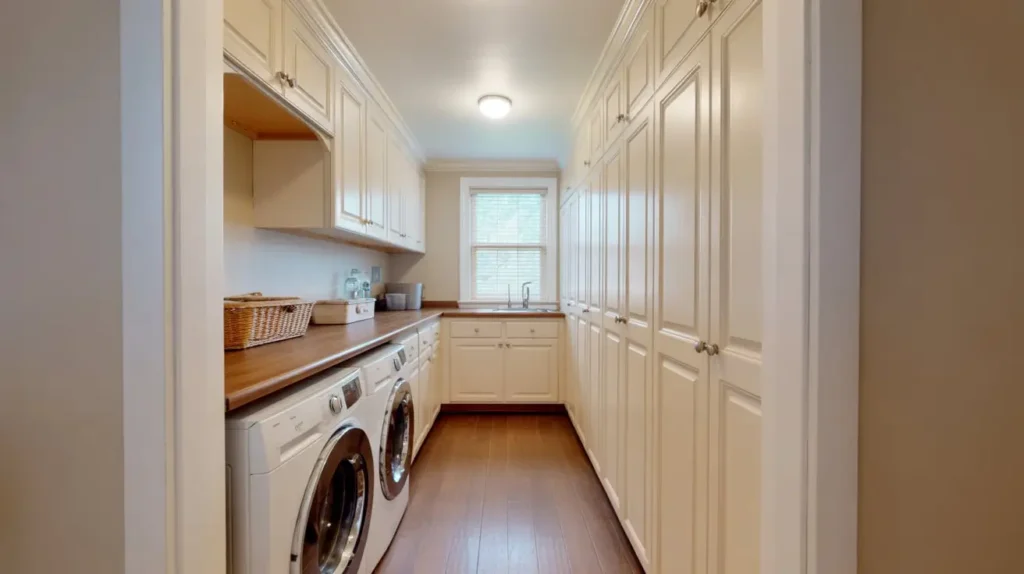
If you have a narrow passthrough space—like a long hallway, a mudroom, or an extended part of your kitchen—the galley-style layout is your new best friend. It’s modeled after a ship’s galley, designed for maximum efficiency in a tight corridor.
The setup is simple: you line one wall with your laundry appliances and some counter space. The opposing wall becomes a floor-to-ceiling pantry with shallow shelves. This creates a highly functional “work corridor” where everything is within arm’s reach.
The Workflow is Everything
What I love about the galley style is the intuitive workflow. You can pull clothes from the washer, fold them on the countertop opposite, and store cleaning supplies in the pantry shelves right next to you. It turns laundry day into an assembly line of efficiency. The narrowness of the space, which might seem like a disadvantage, actually becomes a strength because you take fewer steps.
Making a Galley Work for You
The key to a successful galley layout is maintaining enough clearance between the two sides. You need enough room to comfortably stand, bend over, and open appliance doors without feeling like you’re in a straightjacket. A minimum of 36 to 42 inches of walkway space is a good rule of thumb.
- Pantry Shelving: Use shallow shelves (around 12 inches deep) for the pantry side. This prevents items from getting lost in the back and makes it easy to see everything at a glance.
- Countertop Magic: A countertop over side-by-side appliances is non-negotiable in this setup. It provides a much-needed surface for folding clothes, pre-treating stains, or even just setting down your grocery bags.
Read Also 15 Smart Small Living Room Ideas for Cozy Modern Spaces
5. The Tall Cabinet Pantry Laundry
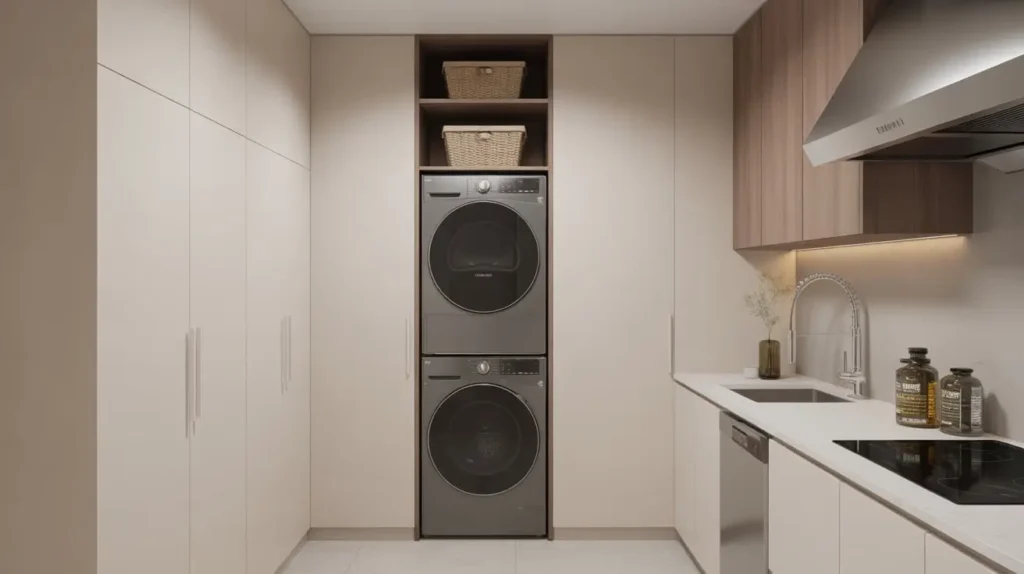
This is a more contained, modular version of the “Hidden Washer Pantry Wall.” Instead of dedicating an entire wall, you use one or two tall, standalone pantry cabinets (like the ones from IKEA’s PAX or SEKTION series) and customize them to house your laundry setup.
Think of it as a laundry armoire. One tall cabinet can be configured to hold a stacked washer and dryer. The adjacent cabinet can be fitted with shelves and drawers for all your pantry and cleaning needs. It’s a beautifully self-contained unit that can be placed in a kitchen, dining area, or even a living room corner without looking out of place.
The Beauty of a Modular Approach
The flexibility here is fantastic. You don’t need a major renovation or custom-built cabinetry. You can achieve a high-end, integrated look using more affordable, off-the-shelf components. This makes it a great option for renters or those on a tighter budget.
A Quick Reality Check
Before you run off to IKEA, measure, measure, and measure again. You need to ensure the internal dimensions of the cabinet can accommodate your appliances, including the necessary clearance for ventilation and hoses in the back. Also, you’ll likely need to cut out the back panel of the cabinet for plumbing and electrical access. It’s a bit of a DIY project, but the payoff is huge.
- Reinforce It: These cabinets aren’t always designed to hold the weight and vibrations of a washing machine. You should securely anchor the cabinet to the wall and may even want to reinforce the base.
- Appliance Choice: This setup is perfect for compact, European-style 24-inch appliances, which are designed to fit into standard cabinetry.
6. The Pocket Door Utility Combo
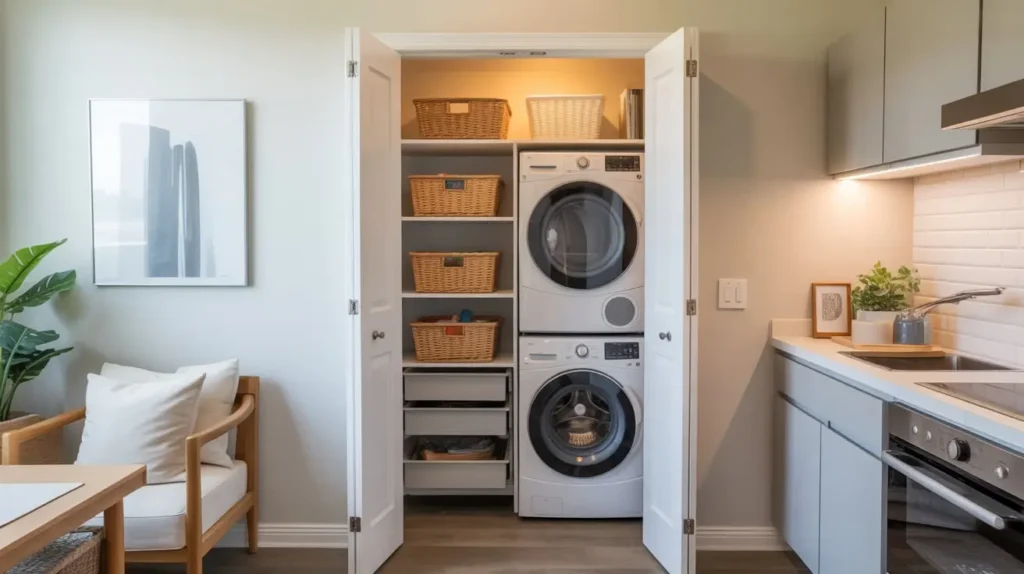
I’m giving pocket doors their own special mention because, honestly, they deserve it. While I touched on them with sliding doors, a pocket door is a specific type of slider that is just chef’s kiss for creating a hidden utility closet.
Unlike a barn door that remains visible, a pocket door vanishes completely into the wall. This is the pinnacle of space-saving design. You can turn a shallow closet or an awkward nook into a fully functional pantry laundry combo, and when the door is closed, it’s like it was never there. The wall is just a wall.
Why I’m Obsessed with Pocket Doors
The seamlessness is what gets me. It allows you to “borrow” space from a main room without visually chopping it up. Have a wide spot in a hallway? Frame it out, install a pocket door, and boom—you have a new utility room. It feels like a magic trick.
The Installation Factor
Okay, let’s be upfront. Installing a pocket door is more involved than hanging a regular door. It requires opening up the wall to install the track and frame. It’s not a casual weekend project unless you’re very handy. However, if you’re already doing a renovation, I strongly urge you to consider adding one. The functional benefit in a small home is immeasurable. FYI, it’s much easier to install one in a new wall than to retrofit it into an existing one.
- Hardware Matters: Don’t cheap out on the pocket door hardware. A flimsy track will lead to a wobbly, frustrating door. Invest in a heavy-duty, high-quality track and roller system for smooth, quiet operation.
7. The Open Shelf Laundry Pantry
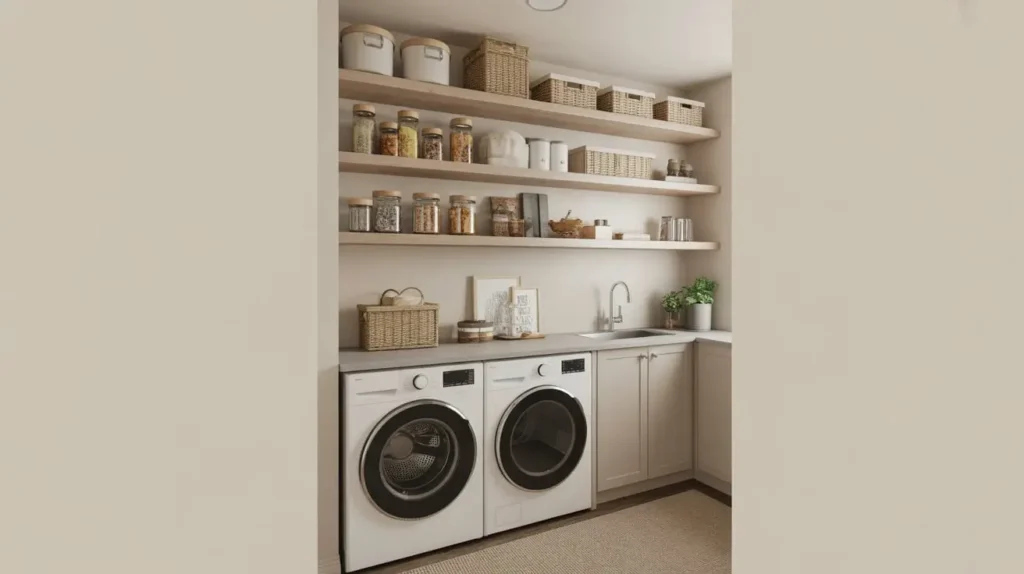
This one is for the brave, the bold, and the impeccably tidy. The open shelf concept ditches doors and cabinets entirely in favor of, you guessed it, open shelving. It’s a look you often see in trendy cafes and minimalist apartments, and it can be stunningly beautiful when done right.
You dedicate a wall or a nook to your laundry-pantry station. The appliances sit on the floor or a low platform, and a system of open shelves extends above and around them. These shelves hold everything from your detergent and dryer balls to your collection of artisanal jams and fancy olive oils.
The Brutal Honesty of Open Shelves
There is nowhere to hide. This is the biggest pro and the biggest con. The pro? Everything is visible and easy to grab. You’ll never buy a third bottle of soy sauce because you couldn’t find the other two. The con? It forces you to be organized. IMO, this is actually a good thing. It encourages you to decant items into beautiful jars and use coordinated baskets, turning your everyday necessities into a curated display.
How to Not Make It Look Like a Mess
- Curate Your Containers: This is the secret sauce. Invest in a set of matching glass jars for things like pasta, rice, and laundry powder. Use woven or wire baskets to corral smaller, less attractive items.
- Edit Your Collection: Open shelving is not the place for that half-empty, crinkled bag of flour. Be ruthless about what gets to be on display.
- Add a Countertop: A simple butcher block or laminate countertop over your appliances provides a visual break and a functional workspace, making the whole setup feel more polished.
8. The Stacked Appliance Pantry Nook
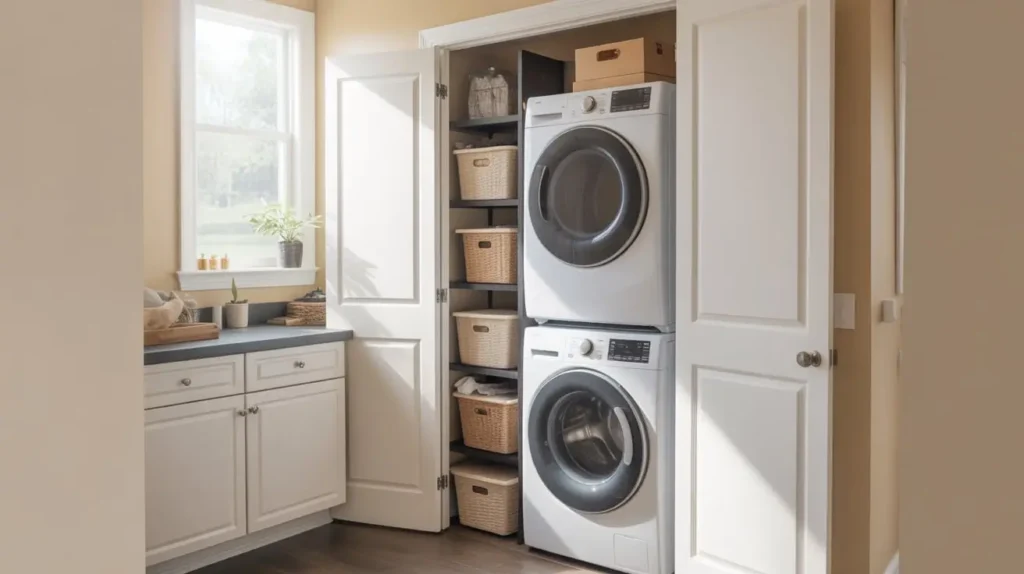
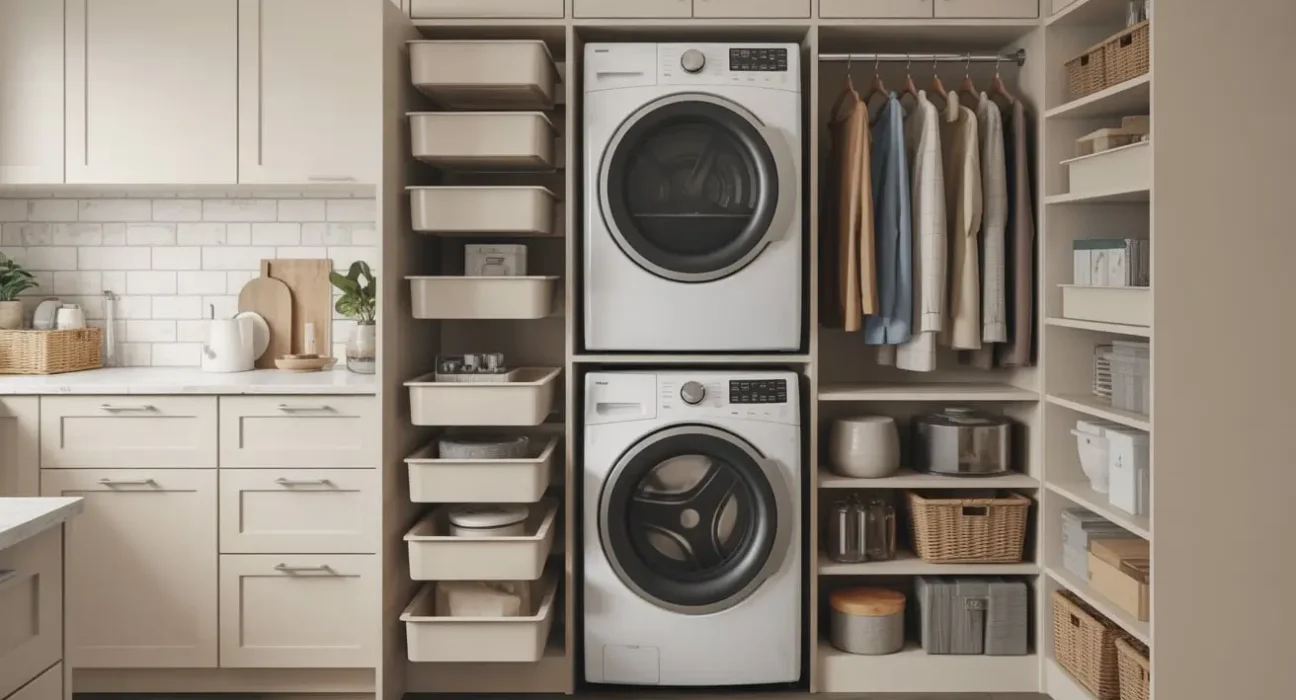
Stacking your washer and dryer is the oldest trick in the small-laundry-room book, and for good reason. It cuts the floor space required for your appliances in half. This instantly frees up room for a narrow, floor-to-ceiling pantry cabinet or shelving unit right next to the stack.
You can tuck this compact combo into a closet, an alcove at the end of a hall, or even a corner of your kitchen. It’s one of the most space-efficient layouts possible.
Maximizing the Nook
The key is to use the newly freed-up space wisely. A tall, skinny pull-out pantry is a fantastic option here. It allows you to access items from both sides and prevents anything from getting lost in the back. Alternatively, simple built-in shelves can provide ample storage for pantry staples and cleaning supplies.
What You Need to Know Before You Stack
Not all washers and dryers can be stacked! You need to buy models that are specifically designed to be stackable and purchase the corresponding stacking kit. This kit is a special bracket that securely locks the dryer on top of the washer, preventing it from vibrating off during a spin cycle. Please, for the love of all that is holy, do not just place a dryer on top of a washer without a kit. That’s a recipe for disaster.
- Height Considerations: A stacked unit can be quite tall. Make sure you can comfortably reach the dryer controls. Some models have controls that are easier to reach or can even be controlled via a smartphone app.
- Vibration Pads: Place anti-vibration pads under the feet of the washer to minimize noise and movement, especially if it’s on an upper floor or in a main living area.
9. The Corner Pantry Laundry Setup
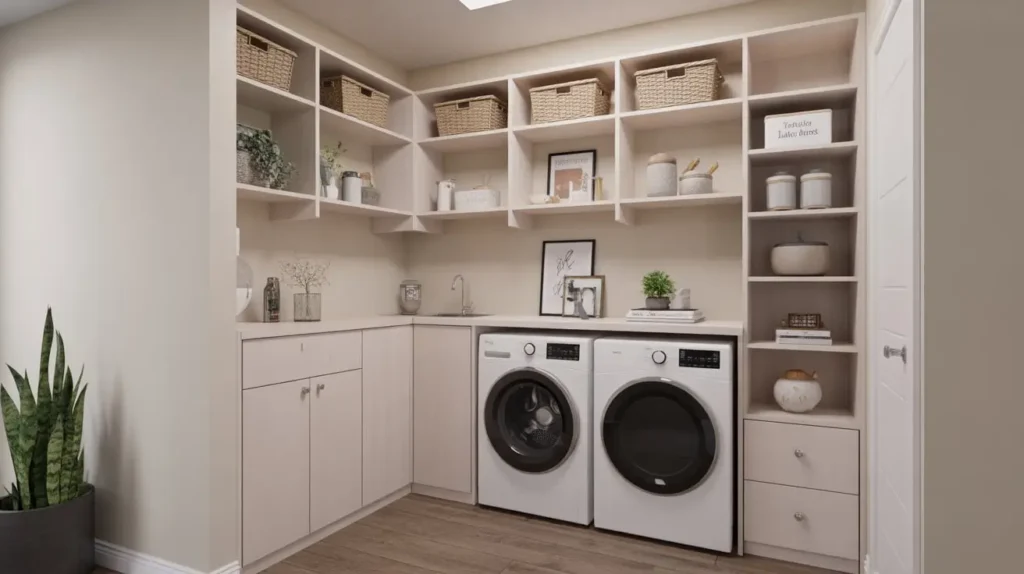
Corners are often the most awkward and underutilized spaces in a home. They become a graveyard for dusty plant stands or a lonely-looking floor lamp. But with a bit of clever design, you can transform that dead corner into a powerhouse of productivity.
A corner pantry laundry setup typically involves custom-built or angled cabinetry that fits snugly into a 90-degree corner. You can place a compact washer or an all-in-one washer-dryer unit inside, with angled or L-shaped shelving above and around it for pantry storage.
Taming the Awkward Corner
The goal is to make the corner accessible. This is where clever storage solutions shine.
- Lazy Susans: Install large lazy Susans (turntables) on the shelves so you can easily spin them to reach items in the back.
- Diagonal Shelving: A large, diagonal cabinet can create a walk-in pantry feel, even in a small footprint.
- Appliance Choice: An all-in-one washer-dryer combo unit is often a perfect fit for a corner, as it requires only one appliance footprint.
Is It Worth the Customization?
This idea often requires a bit more custom work than others, as standard rectangular cabinets don’t fit corners efficiently. However, the payoff is huge because you’re creating functional storage out of thin air. You’re taking a space that had zero value and turning it into one of the hardest-working spots in your home.
Read Also 15 Stunning Small Space Living Room Ideas That Maximize Comfort
10. The Farmhouse Pantry Laundry Combo
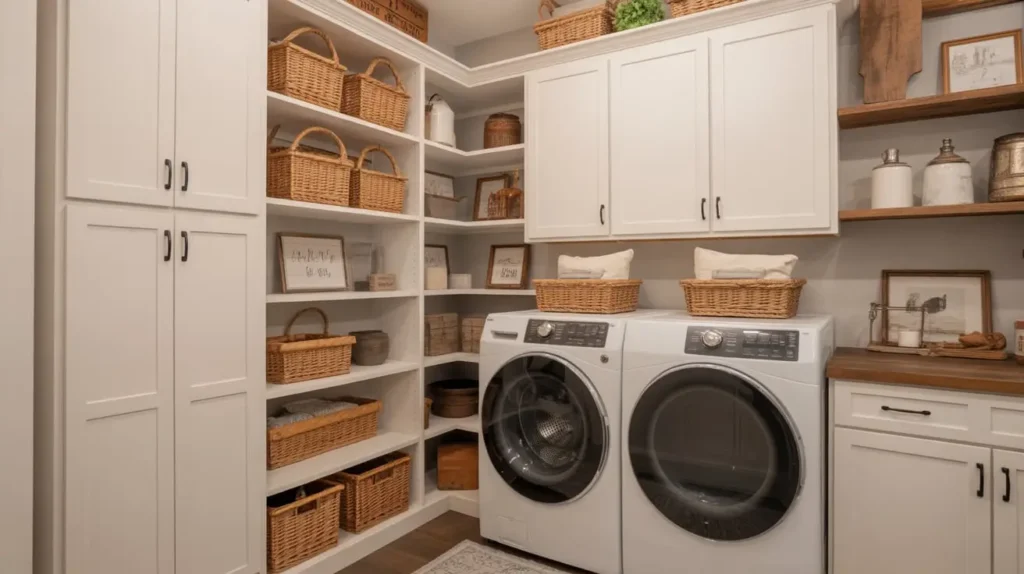
If your aesthetic leans more towards cozy, rustic, and charming, the farmhouse pantry laundry combo is for you. This is less about a specific layout and more about the materials, textures, and overall vibe. It’s about making a functional space feel warm and inviting.
Think shiplap walls, a deep apron-front sink for hand-washing delicates, and a warm butcher block countertop for folding. The pantry storage might consist of open wooden shelves, wire baskets, and vintage-style glass jars. The laundry appliances themselves can be hidden behind a charming sliding barn door.
Key Elements of the Farmhouse Look
- Shiplap or Beadboard: Adding this to the walls instantly injects a rustic, textured feel.
- Butcher Block Countertop: A thick wood countertop over the appliances adds warmth and is incredibly practical.
- Open Wood Shelving: Use reclaimed or simple pine boards for an authentic, unfussy look.
- Natural Baskets: Woven baskets made of seagrass, rattan, or hyacinth are perfect for storing linens and hiding less-aesthetic supplies.
- Apron-Front Sink: If you have the space and plumbing, a utility sink is a game-changer for a laundry area.
It’s More Than Just Looks
While the farmhouse style is beautiful, it’s also deeply practical. The materials are durable and meant to be used. The emphasis on open storage and functional surfaces makes it a very user-friendly setup. It’s a design style that celebrates utility instead of trying to hide it.
11. The Minimalist White Utility Pantry
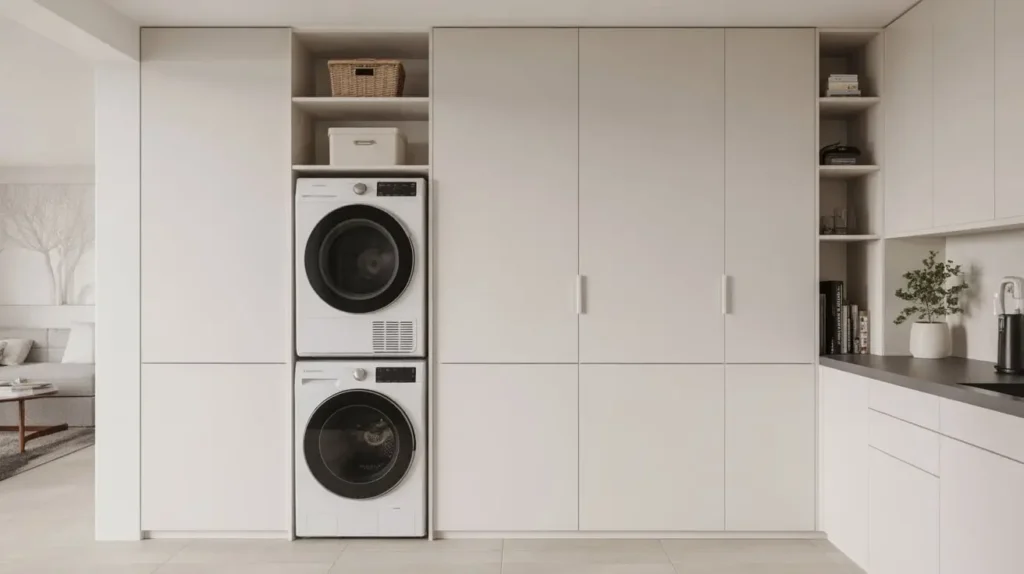
On the opposite end of the spectrum from the rustic farmhouse look is the sleek, minimalist white utility pantry. This approach is all about creating a space that feels bright, clean, and expansive, even if it’s tiny.
The formula is simple: white, white, and more white. White walls, white flat-panel cabinets, white countertops, and even white appliances. The lack of color and visual noise tricks the eye into seeing a larger, more serene space. It’s a fantastic strategy for a laundry pantry located in a dark closet or a windowless room.
The Power of Simplicity
This design works because it removes all distractions. The focus is purely on function.
- Handleless Cabinets: Use push-to-open or integrated-pull cabinets for a completely seamless, flat surface. This enhances the minimalist feel.
- Glossy Finishes: High-gloss white cabinets and countertops will reflect light, making the space feel even brighter and bigger.
- Concealed Everything: This style pairs beautifully with the “Hidden Washer Wall” or “Tall Cabinet” ideas. The goal is to hide the appliances and the clutter behind a wall of uniform white doors.
Keeping it From Feeling Sterile
Worried it might look like a hospital room? The key is to introduce subtle texture. A white subway tile backsplash with a light grey grout, a lightly veined white quartz countertop, or some simple green plants can add warmth and interest without compromising the minimalist aesthetic.
12. The Mudroom Style Pantry Laundry
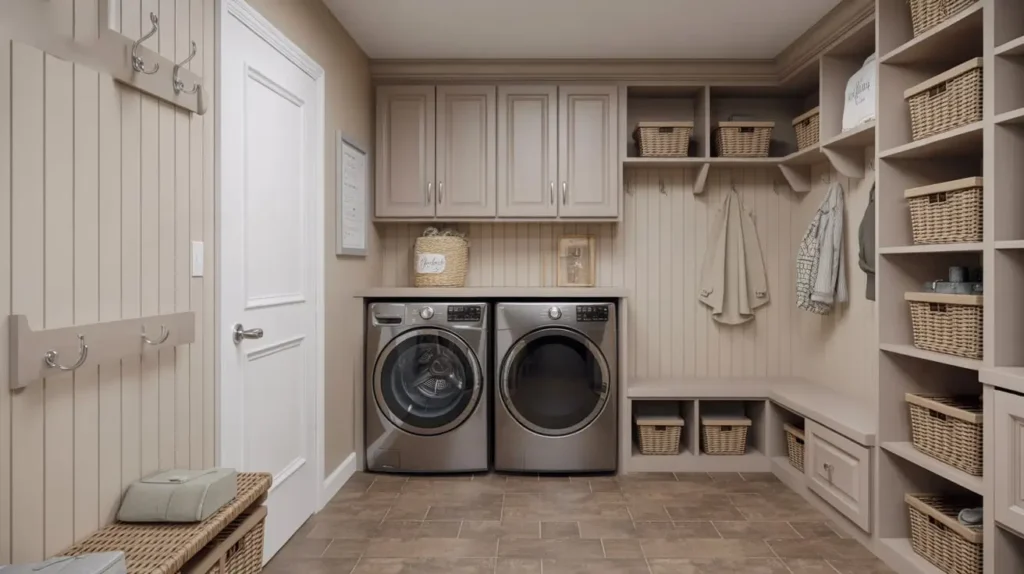
If your pantry laundry combo is located near an entryway, why not lean into it and create a full-blown mudroom? This is the ultimate workhorse of home design, combining three essential functions—entryway drop-zone, pantry storage, and laundry—into one super-efficient space.
The layout typically features a bench for taking off shoes, with cubbies or drawers underneath for storage. Above the bench, you’ll have hooks for coats and bags. On the adjacent wall or in a bank of tall cabinets, you house your laundry appliances and pantry.
Designing the Ultimate Triage Center
A mudroom is your home’s first line of defense against the chaos of the outside world.
- Durable Flooring: Choose flooring that can handle dirt, mud, and water. Luxury vinyl tile (LVT) or porcelain tile are excellent, easy-to-clean choices.
- The “Drop Zone”: The bench and hooks are crucial. This gives every member of the family a designated spot for their stuff, preventing it from migrating into the rest of the house.
- Integrated Storage: The pantry and laundry elements should feel built-in and intentional. Tall cabinets that house both food and your stacked washer/dryer are a great way to keep things looking tidy.
This is a fantastic solution for families with kids and pets. You can throw muddy sports uniforms or wet towels straight into the washing machine the moment they come through the door.
13. The Pull-Out Storage Pantry Laundry
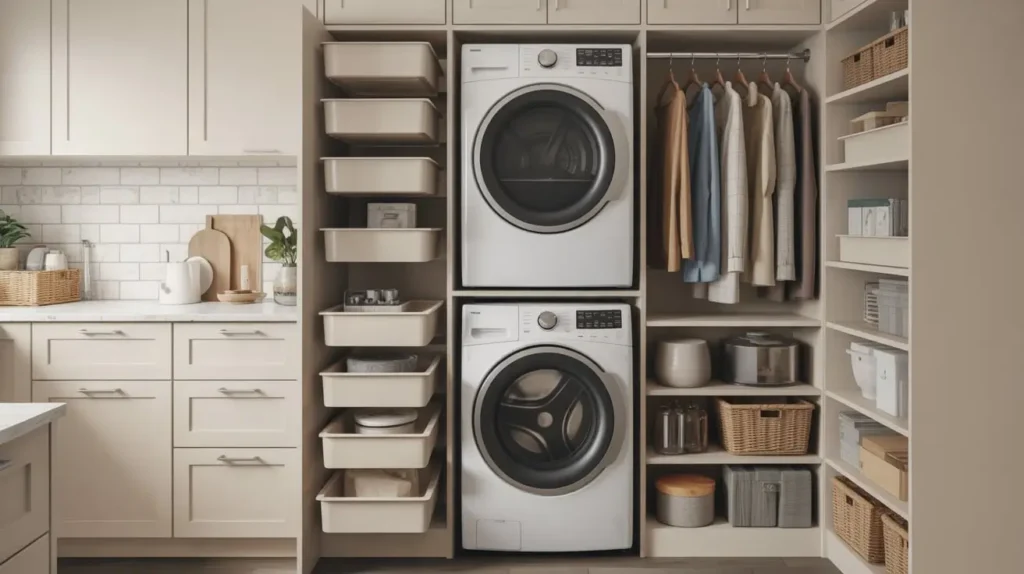
This idea focuses on a specific type of storage that is an absolute game-changer in any small space: pull-outs. Instead of fixed shelves where things get lost in the dark depths, you install shelves and racks on sliding mechanisms. With a gentle tug, the entire contents of your pantry glide out to meet you.
Imagine a tall, narrow cabinet next to your stacked laundry unit. Instead of shelves, it contains a floor-to-ceiling pull-out rack. You can store dozens of cans, jars, and boxes in a very narrow footprint, and you can see and access every single item from either side.
Why Pull-Outs are a Revelation
- Maximum Accessibility: No more digging around behind old bags of lentils. Everything is visible and within reach.
- Incredible Space Efficiency: They allow you to use deep or very narrow spaces that would be almost useless with standard shelving.
- Versatility: You can find pull-out systems for spices, cans, cleaning supplies, and even ironing boards that fold down.
My Favorite Application
I absolutely love pull-out shelving under a countertop that sits over side-by-side appliances. You can install a deep pull-out drawer to hold laundry baskets or a multi-bin pull-out for sorting recyclables and trash. It’s such a clever use of that often-awkward low space.
14. The Narrow Hallway Pantry Laundry
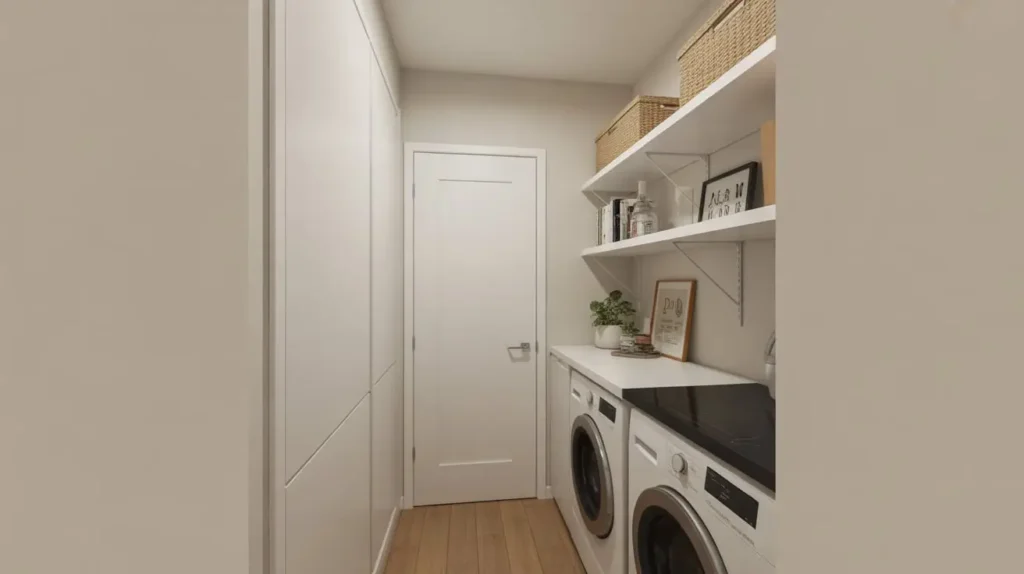
Many homes have a hallway that’s just a little bit too wide to be just a hallway. It’s a “no man’s land” of wasted space. This is a prime opportunity to carve out a pantry laundry combo.
The key to making this work is using shallow-depth appliances and cabinetry. Many brands now offer compact washers and dryers that are several inches shallower than standard models. These are designed for closet installations and are perfect for a hallway setup.
The Hallway Challenge: Maintaining Flow
You must maintain a clear path for foot traffic. This is non-negotiable.
- Doors are Crucial: This is another scenario where sliding or pocket doors are essential. A swinging door would completely block the hallway.
- Shallow is the Word: The entire unit—appliances and pantry shelving—should be as shallow as possible. Aim for a total depth of 28-30 inches if you can.
- Visual Tricks: Keeping the cabinetry the same color as the walls can help it visually recede, making the hallway feel less crowded.
This can be a surprisingly effective solution. You’re taking a transitional space and giving it a powerful, hidden function.
15. The Built-In Cabinet Laundry Pantry
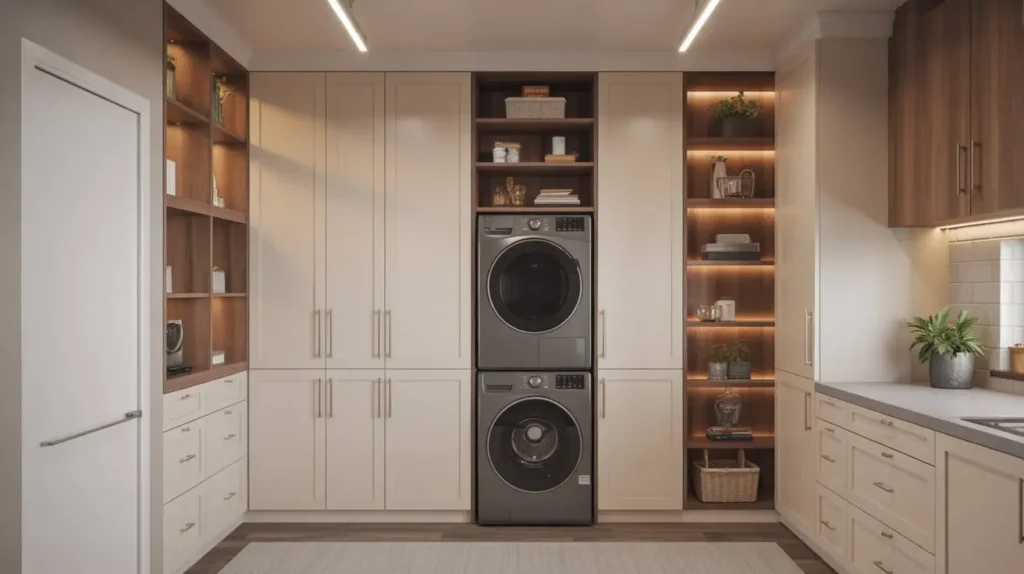
Last but certainly not least, we have the gold standard: the fully built-in cabinet combo. This is similar to the hidden wall or tall cabinet ideas but taken to the next level of customization and integration. It involves creating a custom-milled wall of cabinetry that looks like it has always been a part of your home’s architecture.
This approach offers the most seamless and high-end finish. The built-ins can be designed to perfectly match your kitchen cabinets or other millwork in your home. You can include custom features like a pull-out folding shelf, a built-in ironing board, or custom-sized drawers for your specific pantry items.
The Ultimate Custom Job
This is the most expensive option, but it also provides the most value in terms of aesthetics and function.
- Work with a Pro: For a true built-in look, it’s best to work with a skilled cabinet maker or a carpenter. They can deal with uneven walls and floors and create a truly bespoke solution.
- Incorporate Smart Features: Think about what would make your life easier. A charging station for your dust-buster? A dedicated spot for the pet food? With a custom build, you can design it all in.
- Lighting is Key: Integrate LED strip lighting under the shelves or inside the cabinets. Good lighting makes a huge difference in a functional workspace.
A custom built-in is an investment, but it’s one that can dramatically improve your daily life and add significant value to your home.
Your Small Space Has Big Potential
Phew! We made it through all 15 ideas. If your head is spinning with possibilities, that’s a good thing! It means you’re starting to see that you don’t have to be stuck with a frustrating laundry situation just because you live in a small home.
The common thread through all these ideas is cleverness. It’s about looking at your space with fresh eyes and refusing to accept that a “wasted corner” or a “narrow hall” has to stay that way. By combining your pantry and laundry, you’re not just saving space; you’re creating a zone of hyper-efficiency that makes your daily chores a little bit easier.
So, which idea sparked your imagination? Are you ready to embrace the sleekness of a hidden wall, the rustic charm of a farmhouse setup, or the brutal honesty of open shelving? Whatever you choose, you’re on your way to a smarter, more functional home. 🙂
Happy organizing, and may your socks always find their match. (We can dream, right?)