


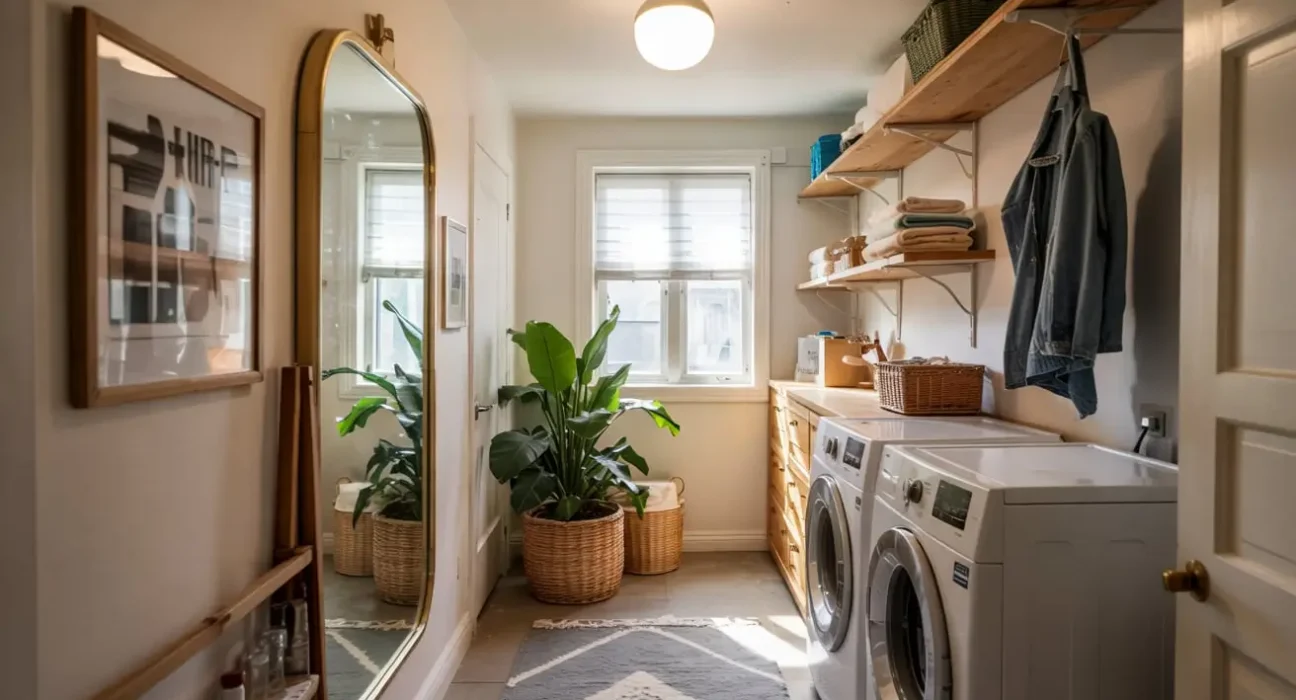
Let’s be real for a second. The “laundry room” in most homes is less of a room and more of a… situation. It’s often a glorified hallway, a tight closet, or that awkward nook you’re not sure what to do with. You know the one. The kind of space where dropping a sock means it’s gone forever, lost to the dusty abyss behind the machines.
I’ve been there. My last apartment had a laundry “closet” so narrow I had to turn sideways to get to the washing machine. Doing laundry felt like a game of human Tetris, and frankly, I was losing. But over the years, I’ve become obsessed with cracking the code to these tiny, challenging spaces. It turns out, you don’t need a massive room to have a functional, or even beautiful, laundry area. You just need to get a little clever.
So, if you’re tired of battling with your washing machine for elbow room, you’ve come to the right place. We’re about to turn that cramped corridor into a lean, mean, laundry-fighting machine. Forget what you think you know about laundry rooms. We’re breaking all the rules and reclaiming our space, one smart idea at a time.
1. One-Wall Laundry Layout

First up is the foundation of any good narrow laundry room design: the one-wall layout. This is exactly what it sounds like. You line up your washer, dryer, and primary storage all along a single wall. Why is this so brilliant? Because it instantly frees up the entire opposite side of the room.
In a narrow space, the battle is for floor space and a clear path. When your machines are on opposite walls, you create a chokepoint. But by putting everything on one side, you create a clean, unobstructed walkway. This layout immediately makes the room feel wider and more intentional, rather than just a place where appliances were shoved.
How to Make It Work
Your first step is to measure everything meticulously. You need to know the exact width of your washer and dryer, plus any desired space between them or on either side for things like a laundry hamper or a slim cart (we’ll get to that later!).
If you have front-loading machines, you can run a single, long countertop over both the washer and dryer. This is a game-changer. Suddenly, you have a massive, uninterrupted surface for sorting, treating stains, and—most importantly—folding clothes. No more folding on your bed! You can buy a pre-made laminate countertop from a home improvement store or get a custom piece of butcher block for a warmer, more high-end feel.
The Perks & The Quirks
The biggest perk is the creation of a functional “zone.” All your laundry tasks happen in one linear progression: sort, wash, dry, fold. It’s efficient and keeps the chaos contained. The main quirk? You’re committing your entire laundry operation to one wall, so you better make sure that wall has the right hookups for water, power, and venting. Moving those can be a pain, so this works best if your hookups are already clustered together.
2. Vertical Cabinet Storage Wall

Okay, so you’ve got your one-wall layout. Now, what do you do with all your stuff? Detergent, fabric softener, dryer sheets, that one random stain remover you bought in 2017… it all needs a home. This is where you look up. I mean, literally. Vertical space is your new best friend.
A vertical cabinet storage wall involves installing tall, floor-to-ceiling cabinets right next to your washer and dryer stack or on the opposite wall. Think of it like a pantry, but for laundry supplies. This gives you an incredible amount of hidden storage without eating into your precious floor space.
How to Make It Work
IKEA is your hero here. Their SEKTION or PAX systems are perfect for creating a custom-looking, built-in wall of storage. You can configure the inside with a mix of shelves, drawers, and even pull-out bins. The goal is to get everything off the floor and out of sight.
- Hide the Mess: Use cabinets to store bulky detergent bottles, extra towels, and cleaning supplies.
- Create a Utility Closet: You can even design a tall cabinet to be wide enough to store your ironing board, mop, and broom.
- Go Handleless: For an extra sleek look in a narrow room, choose flat-panel, handleless cabinet doors. They create a seamless, uncluttered wall that makes the space feel less busy.
The Perks & The Quirks
The best part is that it instantly declutters your room. A visually clean space feels bigger, period. It also keeps laundry chemicals safely out of reach of kids or pets. The downside? It can be an investment, and if you choose dark-colored cabinets, it might make the room feel a bit more closed-in. My advice? Stick to white or a light wood tone.
3. Stackable Washer Dryer Design
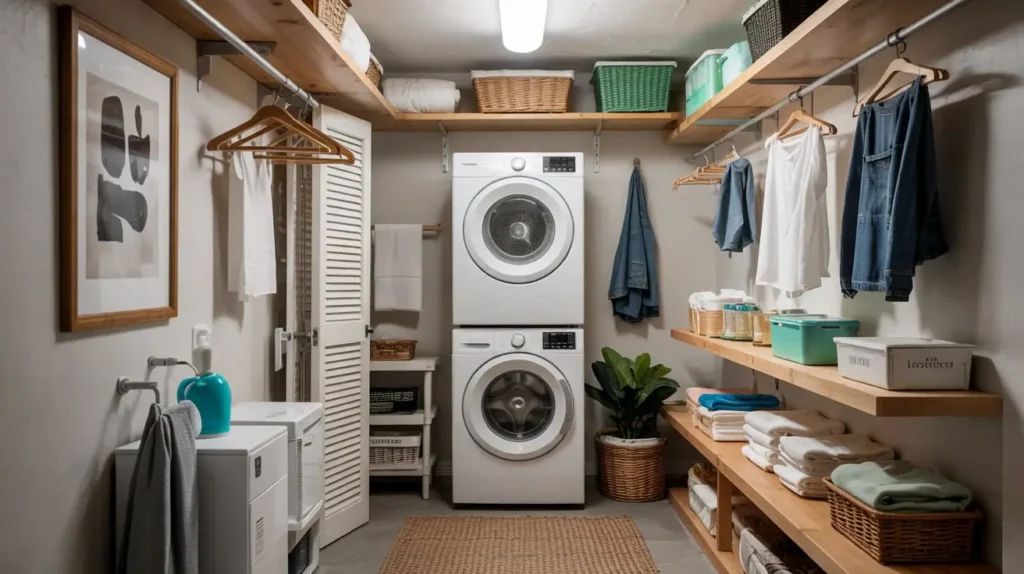
If you want the ultimate space-saving power move, look no further than the stackable washer and dryer. This is the undisputed champion of small laundry rooms. By going vertical with your machines, you literally cut their floor footprint in half.
This move frees up enough space to add a utility sink, a folding counter, or a whole wall of storage cabinets (see idea #2!). It’s the single most impactful change you can make to maximize a narrow laundry room. Ever wondered why so many apartment laundry closets use them? It’s because they just flat-out work.
How to Make It Work
First thing’s first: you need front-loading machines. You can’t exactly stack a top-loader, for obvious reasons. You’ll also need to buy a “stacking kit” that is specifically designed for your make and model. This is not optional! The kit securely fastens the two machines together so the dryer doesn’t vibrate its way into another dimension during the spin cycle.
Pay close attention to the height. Ensure you can comfortably reach the controls on the top machine. Some models have controls for both units on the lower machine, which is a fantastic feature for shorter folks like me. 🙂
The Perks & The Quirks
The primary perk is reclaiming a huge chunk of floor space. It’s a total game-changer. However, there are a few things to consider. Transferring heavy, wet clothes from the washer up into the dryer can be a bit of a workout. Also, if one machine needs servicing, it can be a hassle to unstack them. But IMO, the space you gain is more than worth the minor inconvenience.
4. Floating Shelf Laundry Setup

If built-in cabinets feel too heavy or permanent for your taste, floating shelves are your go-to alternative. They provide essential storage while keeping the room feeling open and airy. This is the perfect solution for people who aren’t afraid to show off their supplies (or for those who are willing to decant their blue detergent into pretty glass jars).
Floating shelves draw the eye upward, creating an illusion of height. In a narrow room, anything that prevents the walls from feeling like they’re closing in on you is a win. Plus, they offer a chance to add a bit of personality with a small plant or a framed photo.
How to Make It Work
The key to successful floating shelves is proper installation and strategic placement. You absolutely must anchor them into wall studs. Laundry detergent is heavy, and you don’t want to wake up to a crash and a soapy tidal wave.
- Placement: Install two or three shelves directly above your washer and dryer. Keep the lowest shelf high enough that it doesn’t get in the way of a top-loading machine’s lid.
- Depth: Opt for shelves that are around 10-12 inches deep. This is deep enough to hold most containers but not so deep that they feel like they’re looming over you.
- Styling: This is where the fun begins. Use woven baskets to corral smaller items, line up your supplies neatly, and leave some “breathing room” on the shelves. An overstuffed shelf will look just as cluttered as a messy countertop.
The Perks & The Quirks
Floating shelves are affordable, stylish, and relatively easy to install. They make the room feel open and allow you to keep frequently used items within arm’s reach. The obvious quirk? Your stuff is on display. If you’re not the tidy type, this might just become a new source of visual clutter. It forces you to be organized, which, depending on your personality, is either a pro or a con.
Read Also 15 Stunning Dream Laundry Room Ideas That Inspire Your Home
5. Slim Rolling Cart Storage
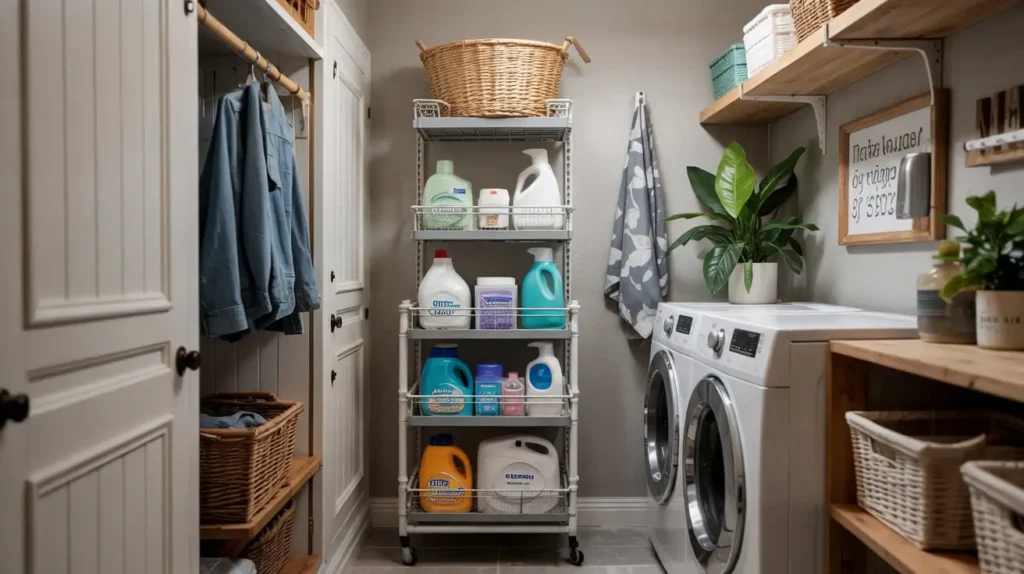
What about that awkward, dusty gap between your washer and dryer? Or between a machine and the wall? It’s a magnet for lint, lost socks, and despair. Enter the slim rolling cart. This is one of my favorite little laundry room hacks because it’s so simple and so effective.
These narrow, multi-tiered carts on wheels are designed to slide right into those useless gaps, instantly turning dead space into a powerhouse of storage. You can use them to hold your detergent, stain removers, dryer balls, and all the other bits and bobs that would otherwise clutter your surfaces.
How to Make It Work
This is almost too easy. Measure the width of the gap you want to fill, then head online. You can find these carts in all sorts of widths, some as narrow as 4-5 inches. Just search for “slim storage cart” or “laundry gap cart.”
When you need something, you just roll it out. When you’re done, you roll it back in, and—poof!—the clutter is gone. It’s like a magic trick. This is an especially brilliant solution for renters, as it requires zero installation and can come with you when you move.
The Perks & The Quirks
The biggest advantage is its ability to reclaim completely unusable space. It’s cheap, requires no DIY skills, and is incredibly versatile. The only quirk I’ve found is that some of the super-cheap plastic models can be a bit flimsy. I’d recommend spending a few extra bucks on a sturdier metal one if you plan on loading it up with heavy liquid detergent bottles.
6. Fold-Down Counter Solution
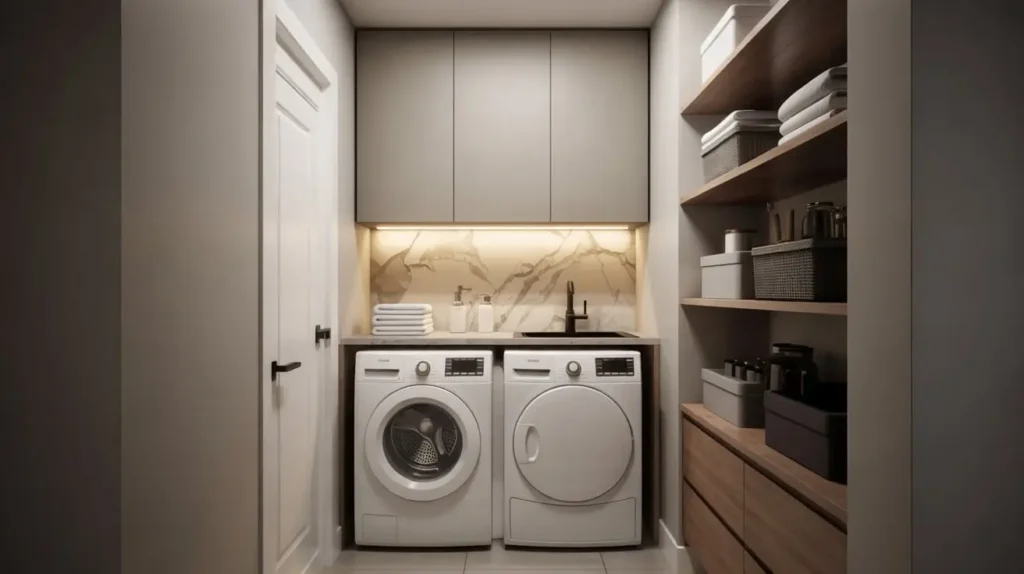
In a narrow laundry room, a dedicated folding area often feels like a pipe dream. Where would you possibly put a table? A fold-down counter, also known as a Murphy-style table, is the answer.
This is a countertop that is hinged to the wall. When you need it, you simply pull it up and lock the legs in place. You get a sturdy, spacious surface for folding, sorting, or even working on a craft project. When you’re finished, it folds back down flat against the wall, taking up virtually no space at all. It’s pure genius.
How to Make It Work
You can find pre-made wall-mounted folding tables online, or you can DIY one with a piece of wood, some heavy-duty hinges, and a pair of folding legs. The most important part is mounting it securely to the wall studs. You want this to be able to handle a heavy pile of wet jeans without crashing down.
Install it on the wall opposite your machines. This way, you can stand in the middle of the room, pull clothes from the dryer, and immediately fold them on the counter behind you. It streamlines the whole process.
The Perks & The Quirks
This gives you a full-size workspace on demand without permanently sacrificing your walkway. It’s the ultimate in multi-functional design. The only real downside is that you have to clear the wall space for it. You can’t have shelves or artwork where the table folds up. But honestly, the trade-off for a real folding surface is well worth it.
7. Overhead Hanging Rod System
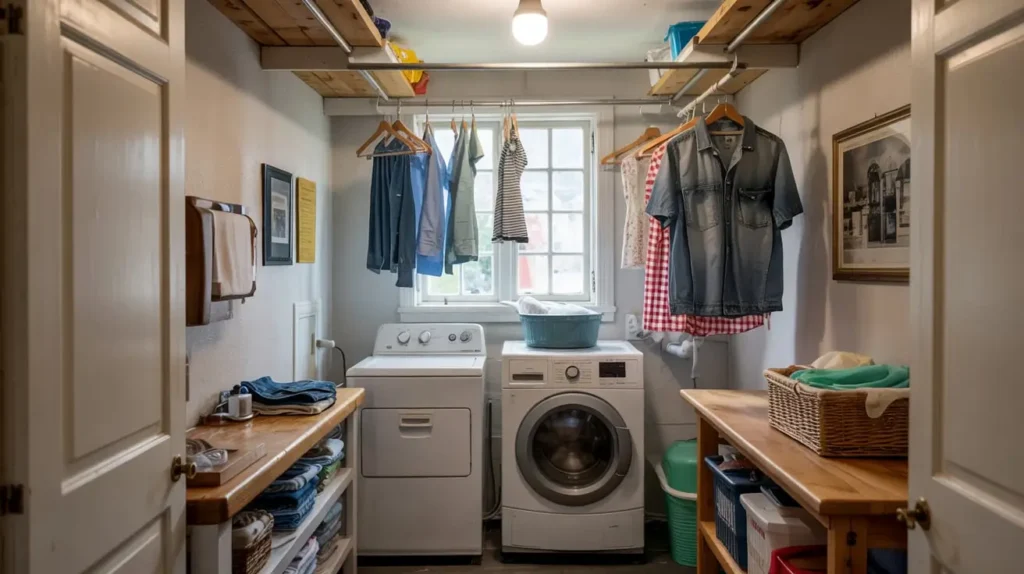
Air-drying delicates or freshly ironed shirts in a small space is always a challenge. You end up with shirts hanging off doorknobs and pants draped over chairs. It’s not a good look. An overhead hanging rod is a simple, elegant solution.
By installing a sturdy rod near the ceiling, you create a dedicated drying space that doesn’t interfere with your ability to walk through the room. It utilizes that empty vertical space above your head that would otherwise go completely unused.
How to Make It Work
You have a few options here:
- Tension Rod: If your laundry room is a true corridor with two parallel walls, a simple, heavy-duty tension rod can work wonders. No drilling required!
- Wall-to-Wall Rod: For a more permanent solution, install closet rod brackets on opposite walls and place a wooden dowel or metal pipe between them.
- Ceiling-Mounted Rod: You can also buy systems that hang down from the ceiling on chains or brackets. This is a great option if you have very high ceilings.
Whatever you choose, make sure it’s installed securely. A rod full of wet clothes is surprisingly heavy. If you’re drilling, hit those studs.
The Perks & The Quirks
This is a low-cost, high-impact solution for air-drying clothes. It keeps your laundry up and out of the way. The only quirk is that you need to be able to reach it. If you have very high ceilings or are on the shorter side, you might want to keep a small, foldable step stool handy.
8. Built-In Wall Niche Storage

If you’re planning a more significant renovation and aren’t afraid of a little drywall work, consider building storage niches directly into the wall. A niche is essentially a recessed shelf that is built into the space between your wall studs.
This is the definition of smart design. You’re creating storage that takes up zero square inches of room space. It doesn’t protrude into the room at all. These niches are perfect for storing neatly folded towels, holding decorative baskets with supplies, or displaying a couple of pretty items.
How to Make It Work
This is a bit more advanced, FYI. It involves cutting into your drywall, framing out a box between the studs, and then finishing it with new drywall and paint. It’s a fantastic weekend project if you’re handy.
You can create a tall, skinny niche that runs from floor to ceiling, or a series of smaller, stacked niches above your countertop. They add a custom, high-end look and create a sense of depth, which can help a narrow room feel a little more expansive.
The Perks & The Quirks
The main benefit is storage that is completely flush with the wall, which is the holy grail in a narrow room. It looks incredibly sleek and custom. The con is that it’s more labor-intensive than just hanging a shelf. It’s also only as deep as your wall cavity (usually about 4 inches), so it’s best for smaller items.
9. Pocket Door Laundry Room
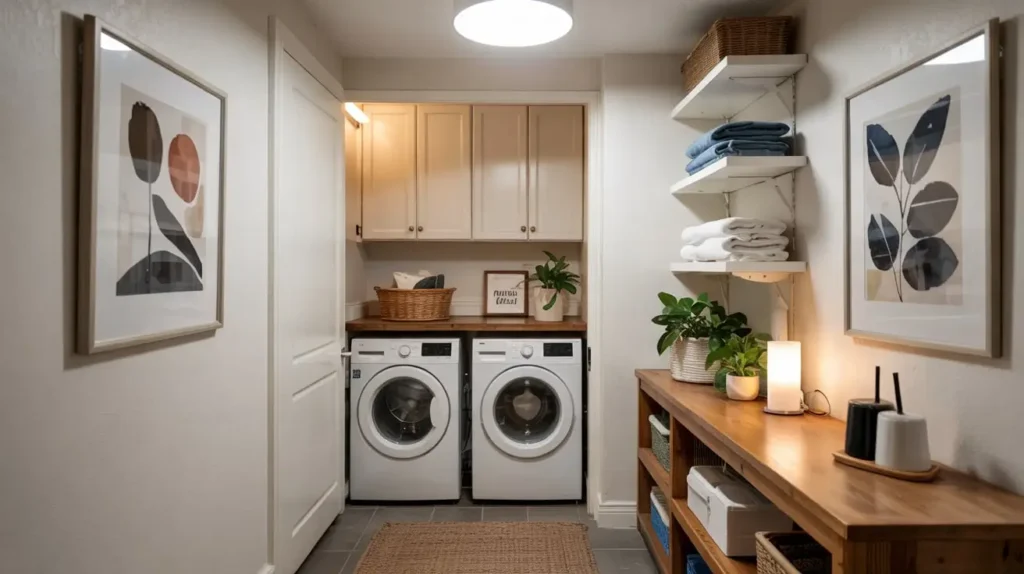
Sometimes the biggest space-waster in a narrow room isn’t an appliance—it’s the door itself. A traditional swinging door that opens into the laundry room can eat up a huge amount of usable space. You have to leave a whole area clear just for the door swing. It’s a logistical nightmare.
The solution? A pocket door. This is a door that slides into a “pocket” inside the adjacent wall, completely disappearing when it’s open. It frees up all that floor and wall space that the swinging door once held hostage.
How to Make It Work
Installing a pocket door is a construction project. It involves opening up the wall, installing a pocket door frame, and then re-drywalling. It’s not a simple swap, so it’s best done during a larger renovation or by a professional.
If a full pocket door is too much, a barn door is a great alternative. It slides along a track mounted above the doorway. It still saves all the interior space, but the door remains visible on the outside wall. It can be a great stylistic statement.
The Perks & The Quirks
The advantage is reclaiming an entire corner of your room. Suddenly you have space for a hamper, a small shelf, or just the freedom to move around. The downside is the installation. It’s more complex and expensive than hanging a standard door. But in a truly tight space, it can be the difference between a functional room and a frustrating one.
Read Also 15 Stunning Laundry Room Wallpaper Ideas That Transform Spaces
10. Light Color Minimal Laundry Design
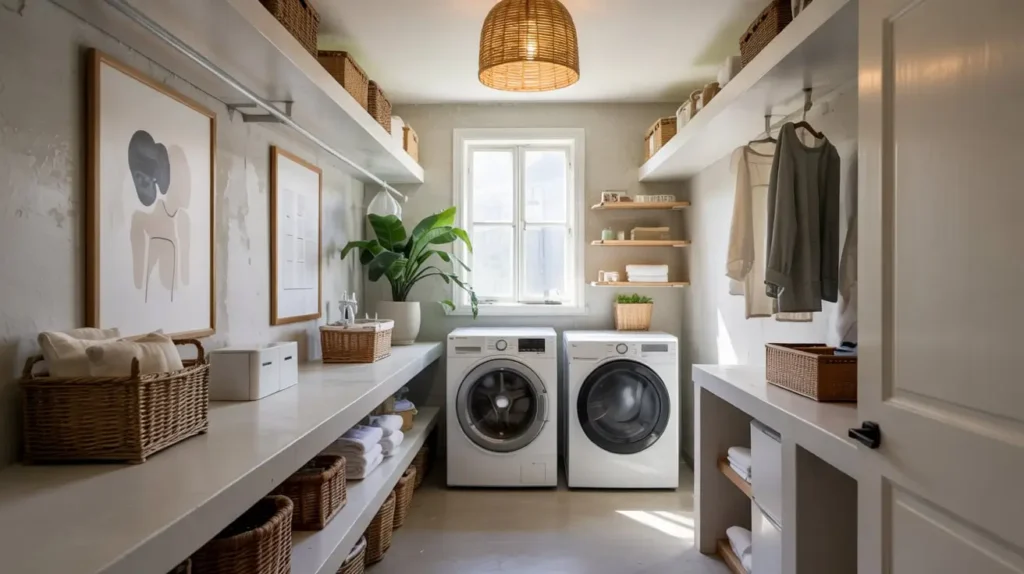
Never underestimate the power of a coat of paint. In a small, narrow room, your color palette is one of the most powerful tools you have. Dark, heavy colors will make the walls feel like they’re closing in, creating a cave-like atmosphere. And let’s be honest, nobody wants to do laundry in a cave.
Embracing a light and minimal design will make your laundry room feel brighter, larger, and cleaner. Think crisp whites, soft grays, pale blues, or light beiges. These colors are excellent at reflecting light, which creates an illusion of spaciousness.
How to Make It Work
It’s about more than just paint. It’s a whole philosophy.
- Paint: Choose a high-quality paint in a satin or eggshell finish. These have a slight sheen that helps bounce light around the room.
- Minimalism: Resist the urge to over-decorate. Keep surfaces as clear as possible. A minimal aesthetic naturally feels less cramped.
- Lighting: Good lighting is non-negotiable. Ditch that single, sad-looking bare bulb. Install a bright flush-mount ceiling light or even some under-cabinet LED strips to illuminate your countertop.
The Perks & The Quirks
A light color scheme is a cheap and incredibly effective way to make any small room feel bigger. It also creates a serene, calming atmosphere, which might just make you hate doing laundry a little less. The “quirk,” if you can call it that, is that a white room shows dirt more easily. But maybe that just motivates you to keep the lint monster at bay. Right? :/
11. Open Shelf Galley Laundry
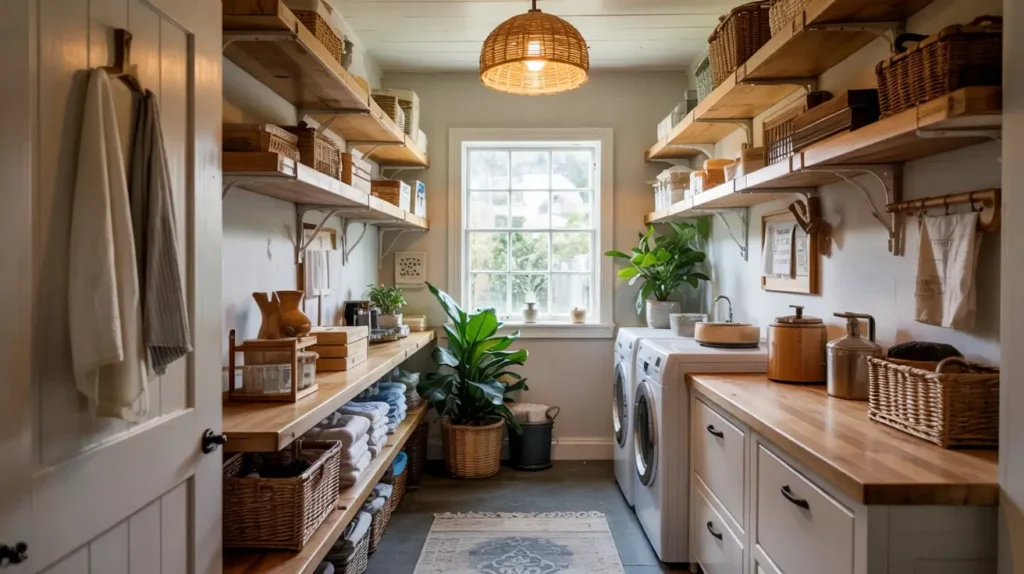
If your laundry “room” is more of a pass-through hallway, you have what’s called a galley layout. This can be tricky because you need to maintain a clear path. This is where open shelving on both sides can work, but you have to be strategic.
Instead of deep cabinets that would make the space feel like a tunnel, slim open shelves can provide tons of storage while keeping things visually light. The key is to vary the depth and not overwhelm the space.
How to Make It Work
On the wall with your machines (which should be a one-wall layout, remember?), you can install shallower shelves above them. On the opposite wall, you could install slightly deeper shelves for holding laundry baskets or folded clothes.
The most important rule for a galley layout is to maintain a clear walkway of at least 36 inches. Any less than that, and it will feel uncomfortably tight. Use a tape measure on your floor to map out your shelves and ensure you’re leaving enough room to walk by, even with a full laundry basket.
The Perks & The Quirks
This design offers a massive amount of easy-access storage. It’s perfect for people who like to see everything at a glance. The challenge is keeping it from looking cluttered. This style demands tidiness. Using matching baskets and containers is essential to creating a cohesive, organized look rather than a chaotic one.
12. Hidden Laundry Behind Curtains
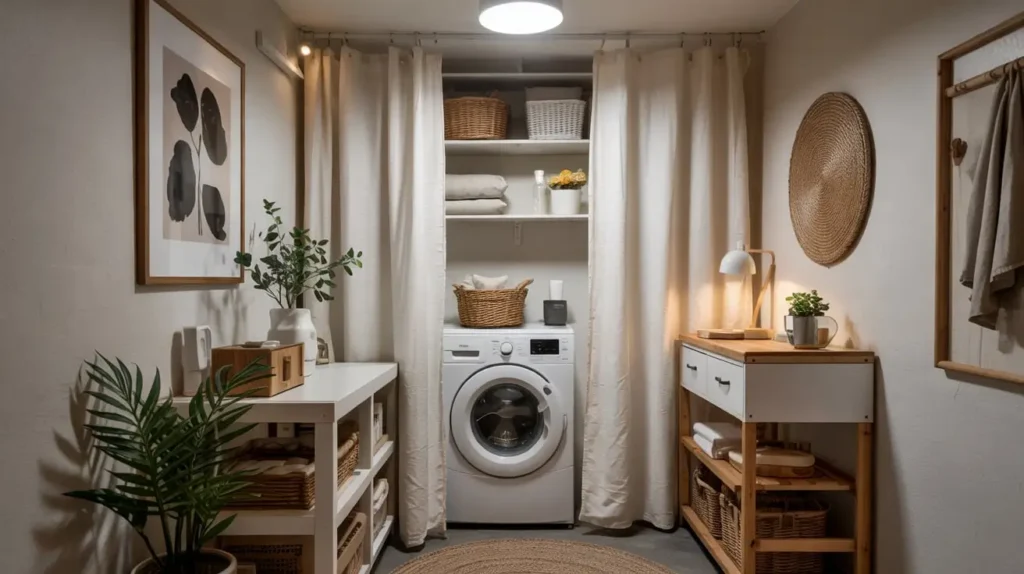
What if your laundry area isn’t a room at all, but is just sitting in a hallway or a corner of your kitchen? You don’t need to build walls to hide it. A simple curtain can do the trick beautifully.
This is a soft, affordable, and stylish way to conceal your machines when they’re not in use. It allows you to instantly hide the visual clutter of your laundry setup, making your hallway or multi-purpose room feel much more put-together.
How to Make It Work
This is one of the easiest DIYs on the list. All you need is a tension rod and a curtain. Measure the width of the alcove or area you want to cover and buy a tension rod that fits. Pick a curtain panel (or two) that matches the style of your home.
You can choose a neutral fabric that blends into the wall, or a bold pattern that turns the area into a feature. It’s much less expensive and invasive than installing a door, and it adds a nice, soft texture to the space.
The Perks & The Quirks
It’s incredibly affordable, requires no tools, and is perfect for renters. It’s a simple and elegant solution for an exposed laundry area. The only quirk is that it’s not soundproof. You’ll still hear the machines running, but at least you won’t have to look at them. It’s a classic case of “out of sight, out of mind.”
13. Wall-Mounted Drying Rack Setup
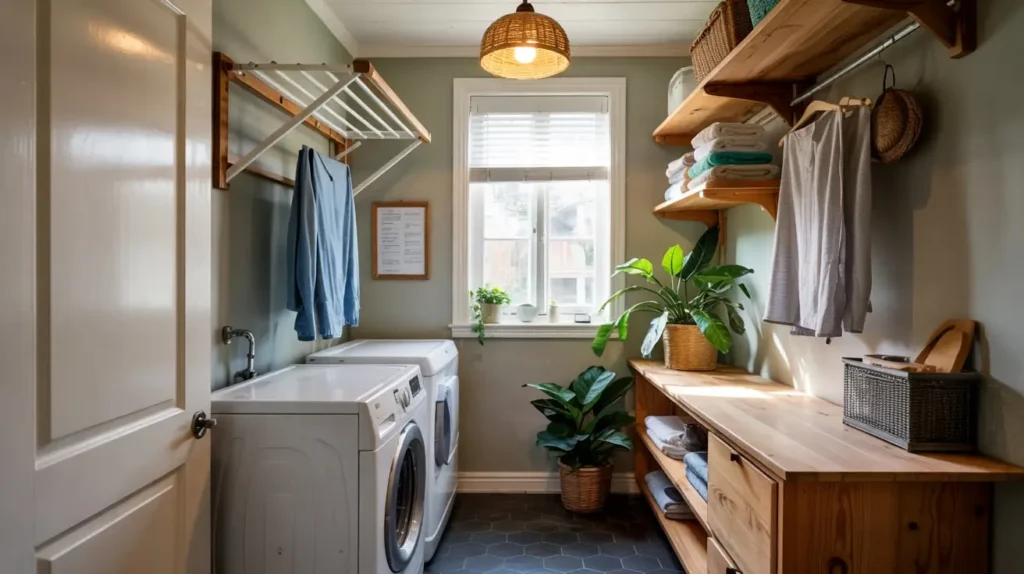
We talked about an overhead hanging rod, but what if you need more drying space than a single rod can offer? A wall-mounted, accordion-style drying rack is an amazing alternative.
These racks are made of a series of rods set in a collapsible frame. They mount directly to the wall and pull out to provide multiple layers of drying space. When you’re done, they fold up completely flat against the wall, taking up almost no room at all.
How to Make It Work
These are available in a variety of materials, from classic wood to modern stainless steel. Find a spot on an open wall—ideally above a waterproof floor, just in case of drips. Again, mounting this securely into studs is critical, as a full rack of wet laundry is very heavy.
Some people install them inside a shallow cabinet for a completely hidden solution, but I personally like the look of a nice wooden or metal one folded flat against the wall. It has a certain utilitarian charm.
The Perks & The Quirks
This provides far more drying space than a single rod in a very compact, foldable package. It’s perfect for families or anyone who air-dries a lot of clothing. The only potential issue is that it does protrude into the room when it’s open, so you need to make sure your walkway is still clear. But since it’s only open when you’re actively using it, it’s a minor inconvenience for a major benefit.
14. Mirror Wall Laundry Trick
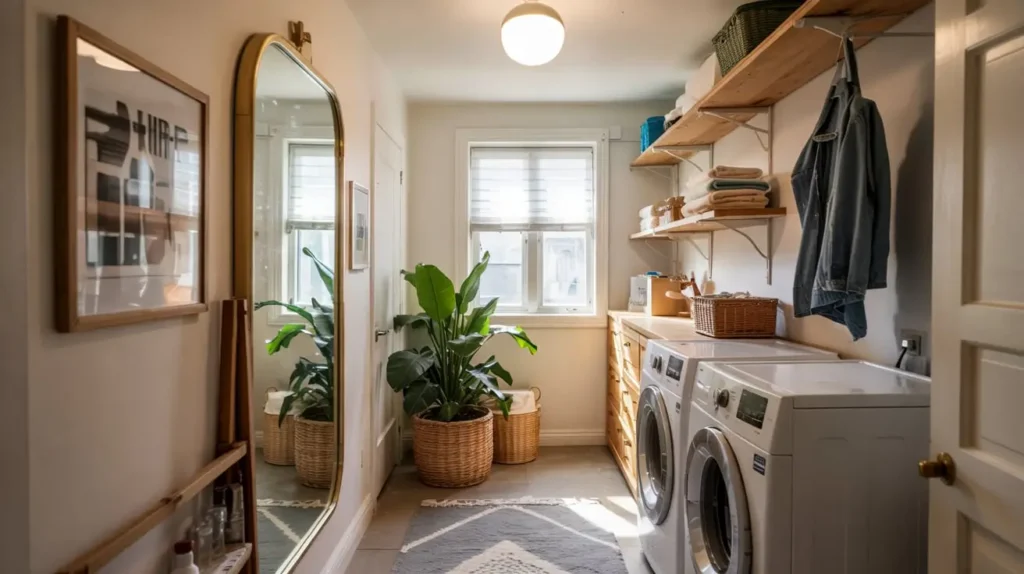
Ready for a little bit of design magic? If you’re feeling bold, installing a large mirror on one of the walls in your narrow laundry room can have a dramatic effect. This is a classic interior design trick for a reason: it works.
A mirror instantly doubles the visual space. It reflects light and the room itself, tricking your brain into perceiving the area as being much wider and more open than it actually is. It’s the ultimate illusion.
How to Make It Work
You can go all out and have a custom mirror cut to fit the entire wall opposite your machines. This will have the most dramatic impact. For a more budget-friendly approach, you can group several large, inexpensive mirror panels together to cover most of the wall.
Placing the mirror on the longest wall will give you the best effect. It will reflect your one-wall laundry setup and the walkway, creating a powerful sense of depth and spaciousness.
The Perks & The Quirks
The pro is undeniable: it will make your narrow room feel exponentially larger. It also bounces light around, making the space feel much brighter. The quirk? Well, you have to look at yourself while you’re doing laundry, which could be motivating or just… a lot. And you have to keep it clean. But for pure, unadulterated space-creating power, nothing beats a mirror.
15. Compact Sink Corner Laundry
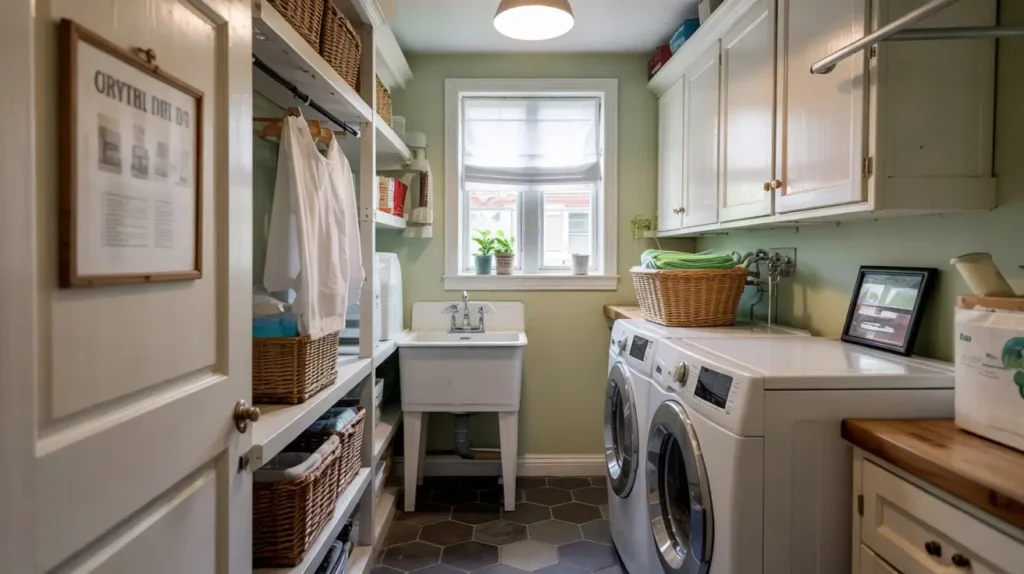
For many, a utility sink in the laundry room is a non-negotiable. It’s essential for hand-washing delicates, treating tough stains, or cleaning up messes. But in a narrow room, where do you put it? The answer: the corner.
Instead of trying to fit a standard, bulky sink next to your machines, look for a compact corner sink or a super-narrow bar sink. These are specifically designed to tuck into tight spaces, making use of what is often an awkward, empty corner.
How to Make It Work
After you’ve stacked your washer and dryer, you might find you have just enough space in a corner for a small sink. You’ll need to have a plumber run the water and drain lines, so this is a more involved project.
Look for models that are specifically labeled as “corner utility sinks” or “narrow bar sinks.” Some even come with a small, integrated cabinet below for extra storage. It’s all about finding a product that’s designed for the exact problem you’re trying to solve.
The Perks & The Quirks
This idea allows you to add the amazing functionality of a sink without sacrificing your main walkway. It’s the perfect way to squeeze in a much-needed feature. The main challenge is the plumbing and installation, which can be an added cost and complexity. But if you’re a serious stain-fighter, having that dedicated sink is worth its weight in gold.
Final Thoughts
There you have it. 15 smart, practical, and sometimes even sneaky ways to conquer your narrow laundry room. That cramped, awkward space doesn’t have to be a source of frustration. With a little creativity and a willingness to think vertically, you can transform it into a highly efficient and maybe even enjoyable place to be.
The key takeaway is this: your room’s limitations are just an invitation to be more creative. Whether you’re stacking your machines, installing a fold-down counter, or just painting the walls a brighter color, every small change adds up.
So go on, measure that gap, buy that rolling cart, and hang that shelf. It’s time to take back your laundry room and maybe, just maybe, stop losing so many socks. You’ve got this.